
Information Ratio Explained: Formula, How to Read It, How It Differs From Sharpe Ratio and How to Judge an Active Fund Manager With It
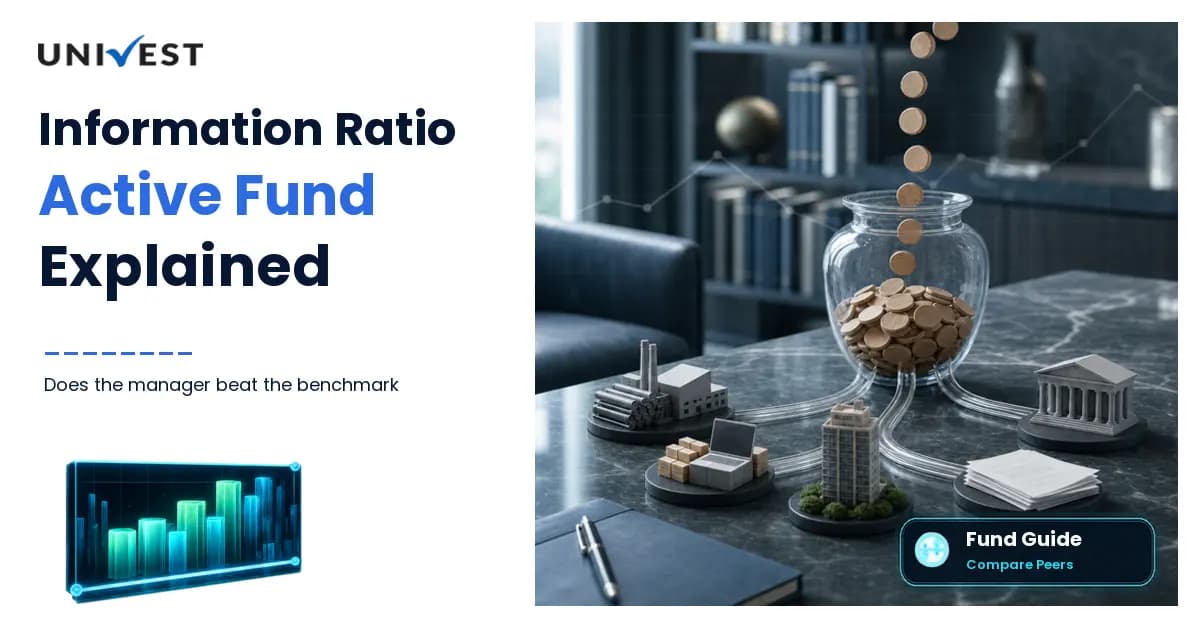
Information ratio = (fund return minus benchmark return) / tracking error. It shows how consistently a manager beats the benchmark. Above 0.5 is good. Compare within one category.
Updated: 20 Nov 2026 • 10:00 am
Posted by:
Quick Answer
Information ratio explained simply: it equals the fund's average return above its benchmark, called active return, divided by the tracking error, which is the volatility of that difference. A higher score means the manager beats the benchmark more consistently for each unit of active risk taken. Scores above 0.5 are generally considered good, and the figure is only useful when compared across funds in the same category and period.
Information ratio explained for investors who want to know whether an active fund manager earns the extra fees: it measures the consistency of outperformance against the benchmark.
This guide covers the formula, a worked example, how to read the score and its limits. It is educational and not a recommendation.
Click Here – Get Free Investment Predictions
Information Ratio Explained: The Formula
Information ratio = (average fund return minus average benchmark return) divided by tracking error. The top part is the active return. The bottom part is the standard deviation of the gap between the fund and the benchmark.
| Item | Meaning |
|---|---|
| Active return | Fund return minus benchmark return |
| Tracking error | Standard deviation of the active return over time |
| Information ratio | Active return divided by tracking error |
Worked Example
| Item | Fund A | Fund B |
|---|---|---|
| Fund return | 14% | 14% |
| Benchmark return | 12% | 12% |
| Active return | 2% | 2% |
| Tracking error | 2% | 6% |
| Information ratio | 1.0 | 0.33 |
Both funds beat the benchmark by 2 percentage points a year, but Fund A did so steadily, while Fund B swung widely around the benchmark. The ratio rewards the steadier manager. The numbers are illustrative.
How to Read the Score
- Above 1: excellent, rare over long periods.
- 0.5 to 1: good.
- 0 to 0.5: modest or inconsistent outperformance.
- Below 0: the fund lags its benchmark.
- Always compare funds in the same category and over the same period.
Information Ratio vs Sharpe Ratio
Use the Univest Screener to check live fundamentals before you act on any idea.
| Feature | Sharpe ratio | Information ratio |
|---|---|---|
| Compared with | Risk free rate | Benchmark |
| Risk measured | Total volatility | Tracking error |
| Question answered | Is the return worth the risk? | Is the manager adding value over the index? |
| Best for | Comparing any funds | Comparing active funds in one category |
An investor in a large cap fund can use the Nifty 50 index, the Nifty 50, as the benchmark and check how consistently the manager beats it.
How to Use It
- Pick the right benchmark for the fund, such as a mid cap index for a mid cap fund.
- Check the ratio for three and five years.
- Compare with the category average.
- Combine with alpha, rolling returns and the expense ratio.
- Prefer funds with a positive ratio across periods, not in a single year.
Consistency is the point of this ratio. Check consistency over rolling windows, not one year. An active fund whose manager beats the benchmark by a small margin every year can score better than one with a single big win. Ask whether the active fund still has the same fund manager, because a new fund manager resets the track record. Also look at the excess return in each year and the NAV history, since a risk adjusted view needs several years of data.
Limits
- A wrong benchmark gives a meaningless score.
- It uses past data, and managers change.
- Index funds have a tiny tracking error, so a small active return can give a large ratio that means little.
- Short periods give unstable results.
- Different platforms calculate it differently, so figures vary.
Download the Univest iOS App or Univest Android App to get daily stock research and market updates.
Conclusion
The information ratio shows whether an active manager beats the benchmark consistently. A ratio above 0.5 over several years is a good sign.
Use the right benchmark and compare within the category.
Disclaimer: Data and figures in this article are sourced from publicly available information. These may or may not be accurate. Please verify all data with the official NSE (nseindia.com) and BSE (bseindia.com) websites before making any investment decision. Investments in securities are subject to market risk. This content is for educational purposes only and is not investment advice by Univest (SEBI RA INH000013776).
Frequently Asked Questions
What is the information ratio in mutual funds?
Ans. It is the fund's return above its benchmark divided by the tracking error. It measures how consistently the manager adds value over the benchmark for each unit of active risk.
What is a good information ratio?
Ans. A score above 0.5 is generally good and above 1 is excellent. Scores near zero show little consistent outperformance, and negative scores show the fund lags its benchmark.
What is tracking error?
Ans. Tracking error is the standard deviation of the difference between the fund's return and the benchmark's return. A low value means the fund stays close to the benchmark.
How is it different from the Sharpe ratio?
Ans. The Sharpe ratio compares the fund return with the risk free rate and total volatility. The information ratio compares it with the benchmark and the volatility of the gap.
Can I use it for index funds?
Ans. It is not meaningful for index funds, since their active return and tracking error are both tiny and the ratio can look odd. Judge them on tracking error and expense ratio.
Which benchmark should I use?
Ans. The one that matches the fund's category, such as a large cap index for a large cap fund. A mismatch makes the ratio misleading.
Where can I find the information ratio?
Ans. Many fund research platforms and factsheets show it for three and five year periods. Figures can differ between sources because of different data and methods.
Recent Articles

Banking and PSU Funds Explained: What They Invest In, Safety Level, Risks and Returns, Taxation and Who Should Consider Them Over Other Debt Funds
19 November 2026

Credit Risk Funds Explained: What They Hold, Why Yields Are Higher, Default Risk, Who Should Avoid Them and How to Check a Fund Before Investing
19 November 2026

Dynamic Bond Funds Explained: How They Change Duration, Who They Suit, Risks and Returns, Taxation and How They Differ From Other Debt Funds
19 November 2026
Alpha in Mutual Funds Explained: What It Measures, How It Is Calculated, How to Read Positive and Negative Alpha and Why It Is Not Enough Alone
19 November 2026
Note: This blog is for information purpose only. Investments and trading are subject to market risks, read all scheme related documents carefully.
Reviews






Recent Posts
Banking and PSU Funds Explained: What They Invest In, Safety Level, Risks and Returns, Taxation and Who Should Consider Them Over Other Debt Funds
Credit Risk Funds Explained: What They Hold, Why Yields Are Higher, Default Risk, Who Should Avoid Them and How to Check a Fund Before Investing
Dynamic Bond Funds Explained: How They Change Duration, Who They Suit, Risks and Returns, Taxation and How They Differ From Other Debt Funds
Alpha in Mutual Funds Explained: What It Measures, How It Is Calculated, How to Read Positive and Negative Alpha and Why It Is Not Enough Alone
Sortino Ratio Explained: Formula, How It Differs From Sharpe Ratio, How to Read a Good Score and How to Compare Mutual Funds With It

Uniresearch Global Pvt Ltd
Research Analyst
SEBI Registration Number — INH000013776
Uniresearch is a subsidiary of Univest Communication Technologies Private Limited
Company Address: Registered Address: Ground Floor, Unitech Commercial Tower 2, Block B, Greenwood City, Unit 1-3, Sector 45, Gurugram, Haryana 122003
Write to us : support@univest.in, compliance@univest.in
Verify on SEBI registry →RESEARCH ANALYST
Get SEBI Registered
advice on the stocks
trending today.
Get 3 FREE Trade Ideas

for Startups Accelerator 2024

Trusted by 1Cr Indians

Awarded No.1 by Economic Times