
Rubber and Plantation Stocks in India with Future Roadmaps as Tyre Industry Raw Material Demand, Natural Rubber Price Recovery, and Diversified Estate Crop Management Reshape a Traditional Kerala-Concentrated Sector
- August 27, 2026
- Posted by: Neeraj Pandey
- Category: Market
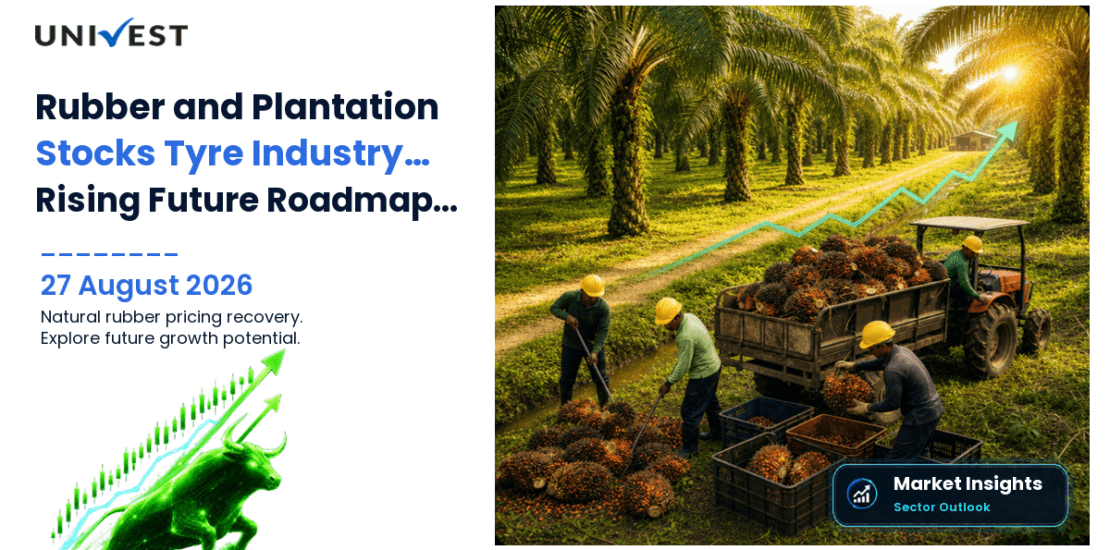
India natural rubber production FY26: 800,000 tonnes+. AVT Natural Products MCap Rs 1,325 Cr, PE 15.81 far below sector 45.43, ROE 11.59%. Harrisons Malayalam PE 13.49 far below sector, ROE 16.31% strong! Thin listed universe, Kerala-concentrated. 5 picks: AVTNATURAL, HARRISONS, RUBBERBOARD(ref), KOTTAYAM(ref), KERALARUBBER(ref).
Quick Answer
Harrisons Malayalam trades at PE 13.49, dramatically below the sector PE of 23.89, with a strong ROE of 16.31%, offering compelling value among rubber and plantation stocks. AVT Natural Products also shows deep value at PE 15.81 with solid ROE of 11.59%. India’s rubber and plantation sector, concentrated in Kerala, benefits from natural rubber demand tied to India’s substantial domestic tyre manufacturing industry, alongside diversification into other plantation crops and natural ingredient extraction.
India’s natural rubber production, concentrated in Kerala, serves the country’s substantial domestic tyre manufacturing industry, which remains significantly dependent on rubber imports despite domestic production, creating a structural demand-supply gap that supports rubber pricing. Diversified plantation companies like Harrisons Malayalam also benefit from multi-crop estate management, reducing dependence on any single commodity price cycle.
For investors, both Harrisons Malayalam and AVT Natural Products offer compelling value combined with solid profitability. All data is as of 26 August 2026.
Click Here – Get Free Investment Predictions
What Are Rubber and Plantation Stocks in India?
Rubber and plantation stocks are shares in companies growing natural rubber and other estate crops, primarily concentrated in Kerala. India’s listed rubber and plantation stocks include AVT Natural Products (natural ingredient extraction alongside plantation interests) and Harrisons Malayalam (diversified estate crops including rubber, tea, and other plantation products).
Budget 2026-27 Impact on Rubber and Plantation Stocks
Click Here – Get Free Investment Predictions
- India’s substantial tyre manufacturing industry creating structural natural rubber demand for rubber and plantation stocks.
- Import substitution potential as India remains a significant rubber importer despite domestic production for rubber and plantation stocks.
- Diversified estate crop management reducing single-commodity price cycle dependency for rubber and plantation stocks.
- Natural ingredient extraction diversification (AVT Natural Products) providing value-added revenue beyond raw rubber.
- Rubber price recovery cycles historically providing periodic margin improvement for rubber and plantation stocks.
5 Rubber and Plantation Stocks in India to Watch in 2026
| Company | CMP (Rs) | Market Cap (Rs Cr) | P/E Ratio | ROE (%) |
|---|---|---|---|---|
| Harrisons Malayalam | 400 | 366 | 13.49 | 16.31% |
| AVT Natural Products | 90 | 1,325 | 15.81 | 11.59% |
| Kerala Rubber and Allied Products (regional reference) | N/A | N/A | N/A | N/A% |
| Kottayam Rubber (regional reference) | N/A | N/A | N/A | N/A% |
| Rubber Board affiliated cooperative reference | N/A | N/A | N/A | N/A% |
Data as of 25 August 2026. For 52-week high/low, verify at nseindia.com before making any investment decision.
1. Harrisons Malayalam (NSE: HARRISONS)
Harrisons Malayalam is a diversified plantation company growing rubber, tea, and other estate crops, trading at PE 13.49, dramatically below sector, with strong ROE of 16.31%. Market cap is Rs 366 crore. Harrisons Malayalam’s diversification and deep value make it the standout choice among rubber and plantation stocks.
2. AVT Natural Products (NSE: AVTNATURAL)
AVT Natural Products extracts natural ingredients including marigold extracts alongside plantation interests, trading at PE 15.81, below sector, with solid ROE of 11.59%. Market cap is Rs 1,325 crore. AVT Natural offers diversified value-added plantation exposure among rubber and plantation stocks.
Check the Univest Screener for Live Fundamental Data on These Stocks
3. Kerala Rubber and Allied Products (regional reference) (NSE: N/A)
Several smaller Kerala-based rubber plantation companies exist but with very limited institutional coverage, illustrating the thin nature of India’s listed rubber and plantation stocks universe beyond the two primary companies covered here.
4. Kottayam Rubber (regional reference) (NSE: N/A)
Additional smaller regional rubber plantation entities operate in Kerala with limited listed equity access, reinforcing the concentration of rubber and plantation stocks investment options around Harrisons Malayalam and AVT Natural Products.
Download the Univest iOS App or Univest Android App to track live prices and expert research.
5. Rubber Board affiliated cooperative reference (NSE: N/A)
India’s Rubber Board, a government body supporting the natural rubber industry through research and farmer support, is not itself a listed entity, but its policy and production support initiatives indirectly benefit rubber and plantation stocks through improved yield and quality standards.
What Factors Affect Rubber and Plantation Stocks?
- Natural rubber price trends as primary revenue indicator for rubber and plantation stocks.
- Domestic tyre industry demand growth as structural indicator for rubber and plantation stocks.
- Rubber import volume trends indicating the demand-supply gap for rubber and plantation stocks.
- Diversified crop yield trends for multi-crop estate companies like Harrisons Malayalam.
- Labour cost trends affecting rubber tapping operations for rubber and plantation stocks.
Benefits of Investing in Rubber and Plantation Stocks
- Harrisons Malayalam’s ROE 16.31% at PE 13.49 offering exceptional value-quality combination.
- India’s structural rubber import dependence supporting domestic rubber and plantation stocks pricing.
- AVT Natural Products’ diversification into value-added natural ingredients beyond raw rubber.
- Domestic tyre industry growth providing sustained baseline demand.
- Diversified estate crop management reducing single-commodity risk for rubber and plantation stocks.
Risks to Consider Before Investing
- Natural rubber price cyclicality creating revenue volatility for rubber and plantation stocks.
- Thin listed universe limiting diversification options.
- Labour cost inflation affecting rubber tapping operation economics.
- Weather-related yield volatility for plantation crops.
- Import competition from Southeast Asian rubber producers with lower costs.
How to Choose Rubber and Plantation Stocks
- Harrisons Malayalam for the best value-quality combination: PE 13.49, ROE 16.31%.
- AVT Natural Products for diversified natural ingredient value addition.
- Monitor natural rubber price trends as primary catalyst.
- Accept the thin listed universe as a structural characteristic of this sector.
- Consider rubber and plantation stocks as a smaller thematic allocation.
How to Invest in Rubber and Plantation Stocks in India
Step 1: Open a SEBI-registered demat account. Univest offers zero-brokerage broking with integrated research, so you can screen, research, and invest in rubber and plantation stocks from one platform.
Step 2: Use the Univest Screener to filter the sector by PE, ROE, D/E, and revenue growth. This gives you a ranked snapshot of all listed rubber and plantation companies.
Step 3: Review financial statements of your shortlist. Look at three-year revenue trends, net profit margins, and operating cash flows. Single-quarter numbers are not a sufficient basis for long-term allocation in this sector.
Step 4: Decide on position size based on your risk tolerance. High-growth rubber and plantation stocks carry more volatility than diversified blue-chips. Diversify across two or three names rather than concentrating in one.
Step 5: Set price alerts and monitor quarterly results. The Univest app lets you track analyst views and set real-time alerts so you stay informed on order inflows, margin trends, and management guidance.
Conclusion
India’s rubber and plantation stocks, led by Harrisons Malayalam with ROE 16.31% at deep value PE 13.49, and AVT Natural Products with diversified value addition, offer compelling value within a thin, Kerala-concentrated sector. India’s structural rubber import dependence and domestic tyre industry demand create supportive fundamentals, though the limited listed universe requires accepting concentration as a sector characteristic. Consult a SEBI-registered investment advisor before making any investment decisions.
Disclaimer: Data and figures in this article are sourced from publicly available information. These may or may not be accurate. Please verify all data with the official NSE (nseindia.com) and BSE (bseindia.com) websites before making any investment decision. Investments in securities are subject to market risk. This content is for educational purposes only and is not investment advice by Univest (SEBI RA INH000013776).
FAQs on Rubber and Plantation Stocks in India 2026
Which are the rubber and plantation stocks in India in 2026?
Ans. Harrisons Malayalam (HARRISONS) trades at PE 13.49 with strong ROE 16.31%. AVT Natural Products (AVTNATURAL) offers value at PE 15.81 with ROE 11.59%.
Why does Harrisons Malayalam trade at such a low PE despite strong ROE?
Ans. Harrisons Malayalam’s deep value PE of 13.49, despite its solid 16.31% ROE, may reflect the traditional, small-cap nature of India’s plantation sector with limited institutional coverage, rather than any fundamental weakness.
How does India’s tyre industry benefit rubber and plantation stocks?
Ans. India’s substantial domestic tyre manufacturing industry requires significant natural rubber input, and since domestic production doesn’t fully meet this demand, rubber and plantation stocks benefit from structural demand support even amid periodic import competition.
What does AVT Natural Products do beyond rubber plantation?
Ans. AVT Natural Products diversifies into natural ingredient extraction, including marigold extracts used in various industrial applications, providing value-added revenue beyond raw commodity rubber production.
Why is India’s rubber and plantation stocks universe so thin?
Ans. Much of India’s rubber cultivation occurs through smallholder farmers rather than large corporate estates, and several plantation companies remain privately held or operate at very small scale, limiting the listed equity universe.
How do I invest in rubber and plantation stocks in India?
Ans. Open a demat account with a SEBI-registered broker. Harrisons Malayalam offers the best value-quality combination. AVT Natural Products provides diversified exposure. Monitor natural rubber price trends. Consult a SEBI-registered investment advisor before investing.
