
RBI Repo Rate Hike to 5.50%: The First Increase Since February 2023, GDP Forecast Raised to 7.1%, the Change to Calibrated Tightening, Home Loan EMI Impact and How Markets Reacted on 7 October
- October 7, 2026
- Posted by: Harsh Piplani
- Category: News
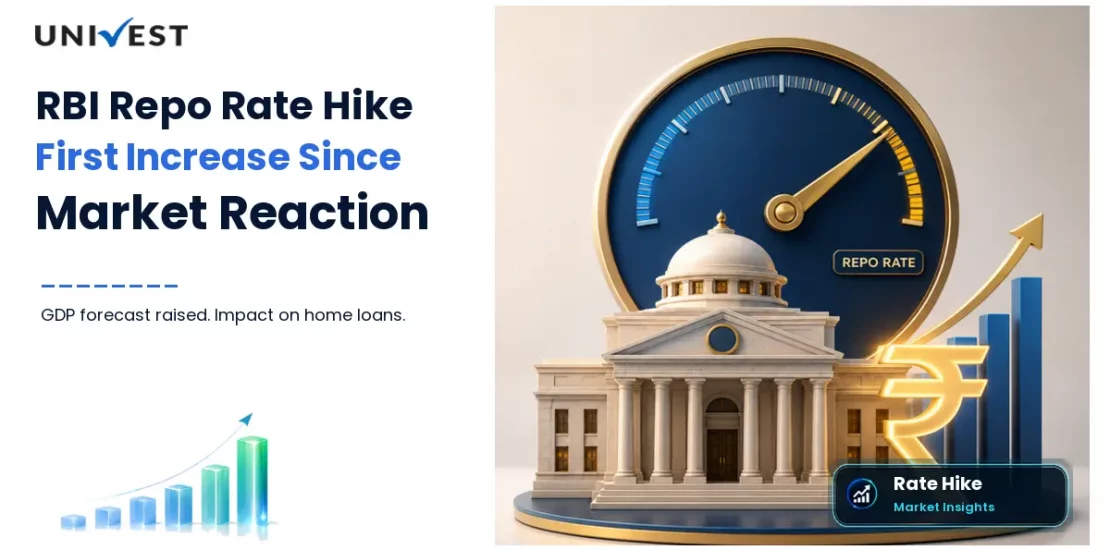
7 Oct: RBI hiked repo 25 bps to 5.50% (unanimous), first since Feb 2023. Stance: calibrated tightening. FY27 GDP 7.1%, CPI 5.2%. Rs 50 lakh loan EMI +about Rs 794.
Quick Answer
RBI repo rate hike of 25 basis points to 5.50% from 5.25% was announced on 7 October 2026 by Governor Sanjay Malhotra, the first increase since February 2023, with all six MPC members voting for it and the stance changed from neutral to calibrated tightening. The RBI raised its FY27 GDP growth forecast to 7.1% from 6.7% and its FY27 inflation forecast to 5.2% from 5%, with quarterly inflation seen at 6% in Q3 and 5.7% in Q4, which is why economists say rate cuts are now off the table. For borrowers, a Rs 50 lakh home loan over 20 years at 8.5% would see the EMI rise by about Rs 794 a month if the full 25 bps is passed on, my calculation, and repo-linked loans typically reset within a quarter. Markets fell modestly, with the Sensex down as much as 529 points at the low, auto and realty stocks weaker and banks recovering, because the hike was widely expected and the stance change was the real signal.
RBI repo rate hike marks a turning point after 125 basis points of cuts in 2025 and four straight pauses at 5.25%, and it comes with oil near $100, a rupee near 96.5 and inflation at 4.82% in August. The decision was announced at 10 am, followed by the Governor’s press conference at noon.
If you have a loan, deposits or investments, this article covers the RBI repo rate hike decision at the RBI MPC October 2026 meeting led by Governor Sanjay Malhotra with a unanimous vote, the calibrated tightening stance, the 7.1% growth and 5.2% inflation forecasts, the SDF and MSF rates, the home loan EMI impact and repo-linked loan resets, what it means for deposits, how the Sensex, Nifty and rupee reacted, what analysts say and what to watch next. Market numbers are intraday, so check the close.
Click Here – Get Free Investment Predictions
RBI Repo Rate Hike: What the RBI MPC October 2026 Meeting Decided on 7 October
| Policy item | New | Earlier |
|---|---|---|
| Policy repo rate | 5.50% | 5.25% |
| Standing deposit facility rate | 5.25% | 5.00% |
| Marginal standing facility and bank rate | 5.75% | 5.50% |
| Policy stance | Calibrated tightening | Neutral |
| MPC vote | Unanimous, 6 to 0 | Four straight pauses before this |
| Real GDP growth forecast, FY27 | 7.1% | 6.7% |
| CPI inflation forecast, FY27 | 5.2% | 5.0% |
The RBI repo rate hike is the first since February 2023, when the rate rose to 6.50%, and it follows cuts that took the repo rate from 6.50% to 5.25% during 2025.
Check the Univest Screener for live data on bank and rate-sensitive stocks
Growth and Inflation Forecasts After the RBI Repo Rate Hike
| Period | GDP growth forecast | CPI inflation forecast |
|---|---|---|
| Q2 FY27 | 7.2% | 4.9% |
| Q3 FY27 | 6.9% | 6.0% |
| Q4 FY27 | 6.8% | 5.7% |
| Q1 FY28 | 7.1% | 5.6% |
| Full year FY27 | 7.1% | 5.2% |
After the RBI repo rate hike, note that the RBI said inflation rose to 4.8% in August from 4.5% in July, and some forecasters expect a reading near 5.5% for September. Projected inflation of 6.0% in Q3 and 5.7% in Q4 helps explain why the RBI chose to tighten despite strong growth.
Home Loan EMI Impact of the RBI Repo Rate Hike
| Loan amount, 20 years | EMI at 8.50% | EMI at 8.75% | Increase per month | Extra interest over 20 years |
|---|---|---|---|---|
| Rs 30 lakh | Rs 26,035 | Rs 26,511 | About Rs 477 | About Rs 1.14 lakh |
| Rs 50 lakh | Rs 43,391 | Rs 44,186 | About Rs 794 | About Rs 1.91 lakh |
| Rs 1 crore | Rs 86,782 | Rs 88,371 | About Rs 1,589 | About Rs 3.81 lakh |
These are my illustrative calculations of the RBI repo rate hike impact, assuming the lender passes on the full 25 bps and keeps the tenure fixed. Loans linked to the repo rate or another external benchmark reset at least every three months, so most borrowers should see a change within a quarter. Lenders usually offer a choice between a higher EMI and a longer tenure, and a longer tenure keeps the EMI unchanged but raises the total interest.
Download the Univest iOS App or Univest Android App to track the Sensex, Nifty and bank stocks live.
What the RBI Repo Rate Hike Means for Deposits and Savers
- Fixed deposit rates are likely to rise over the coming weeks as banks reprice, though banks move at different speeds.
- Savings account rates change little, because they are often fixed by banks for long periods.
- Debt mutual fund yields on new investments may improve, but existing bond holdings can show short-term losses when yields rise.
- Floating-rate loans and credit cards become costlier over time.
- Equity investors should expect margin changes at banks and lower valuations for rate-sensitive sectors.
After the RBI repo rate hike, some large banks already face high deposit costs, since time deposits are growing faster than CASA, so a rise in policy rates adds pressure on funding costs while loan rates reprice faster.
Market Reaction to the RBI Repo Rate Hike
| Measure | Level | Note |
|---|---|---|
| Sensex, Tuesday close | 73,067.81 | After two straight gains |
| Sensex, early low on 7 October | 72,539.18, down up to 529 points | After the announcement |
| Sensex at 12:06 pm | About 72,878, down about 186 points | Down about 0.25% |
| Nifty 50 at 12:06 pm | About 22,683, down about 0.41% | Tuesday close was 22,776.10 |
| Rate-sensitive sectors | Auto down about 1.1%, realty down about 0.6%, FMCG down about 0.6% | Titan and Asian Paints among the top losers |
| Banks | Fell first, then recovered to small gains | Private banks held up |
| Rupee | About 96.54 per dollar | Weaker than 96.45 in early trade |
Because the RBI repo rate hike was in line with the poll, the reaction was mild. The tougher stance, calibrated tightening, was the bigger message, and it dampened hopes for rate cuts.
What Analysts Say About the RBI Repo Rate Hike
| Source | View |
|---|---|
| Aditi Nayar, ICRA | The outcome matched expectations, and the stance change clearly signals that rate cuts are off the table |
| Goldman Sachs | Expects another 25 bps hike in December, which would take the repo rate to 5.75% |
| SBI Research and Nomura | Also expected hikes in October and December |
| HSBC | Had forecast a 25 bps hike and expected September inflation near 5.5% |
The consensus is that the RBI repo rate hike is the start of a short cycle and not a long one, because real rates are still positive and growth is strong.
Risks After the RBI Repo Rate Hike
More hikes: Another 25 bps in December after the RBI repo rate hike would raise EMIs again and weigh on rate-sensitive stocks.
Oil and the rupee: Brent near $100 and a rupee near 96.5 can push inflation above the RBI forecast.
Growth slowdown: Higher loan costs after the RBI repo rate hike can slow housing and auto demand.
Foreign selling: FPIs have sold a record amount of Indian equities this year, and a hawkish RBI does not guarantee they return.
Bond yields: Rising yields hurt existing bond funds and government borrowing costs.
What to Watch Next After the RBI Repo Rate Hike
- The Governor’s press conference remarks on the pace of further tightening.
- Banks’ announcements of lending and deposit rate changes.
- September CPI inflation, expected near 5.5%.
- TCS Q2 results on 8 October and the rest of the earnings season.
- The next MPC meeting in December, where another hike is expected by some economists.
Conclusion
The RBI repo rate hike to 5.50% is the first increase since February 2023, backed by a unanimous vote, a change to calibrated tightening, a GDP forecast of 7.1% and an inflation forecast of 5.2%. Borrowers face higher EMIs of about Rs 794 on a Rs 50 lakh loan if the full hike is passed on, and rate cuts look off the table. Consult a SEBI-registered advisor before making any decision.
Disclaimer: Data and figures in this article are sourced from publicly available information. These may or may not be accurate. Please verify all data with the official NSE (nseindia.com) and BSE (bseindia.com) websites before making any investment decision. Investments in securities are subject to market risk. This content is for educational purposes only and is not investment advice by Univest (SEBI RA INH000013776).
Frequently Asked Questions
What did the RBI MPC October 2026 meeting announce?
Ans. The RBI repo rate hike was 25 bps to 5.50% from 5.25%, the first since February 2023, with a unanimous vote and a stance change to calibrated tightening.
What are the RBI’s new growth and inflation forecasts?
Ans. With the RBI repo rate hike, FY27 GDP growth is 7.1%, up from 6.7%, and FY27 CPI inflation is 5.2%, up from 5.0%.
What are the new SDF and MSF rates?
Ans. After the RBI repo rate hike, the standing deposit facility rate is 5.25% and the marginal standing facility and bank rate are 5.75%.
How much will my home loan EMI rise after the RBI repo rate hike?
Ans. On a Rs 50 lakh loan over 20 years at 8.5%, the EMI rises by about Rs 794 a month if the full 25 bps is passed on, my calculation.
When will my loan rate change?
Ans. Repo-linked and external-benchmark loans reset at least every three months, so most borrowers see the change within a quarter.
Are more rate hikes expected?
Ans. Goldman Sachs, SBI Research and Nomura expect another 25 bps in December, while the RBI has said cuts are off the table.
How did the stock market react?
Ans. The Sensex fell as much as 529 points early, with auto and realty weaker and banks recovering, and the rupee weakened to about 96.54.
Should I prepay my home loan after the RBI repo rate hike?
Ans. This article does not constitute investment advice. After the RBI repo rate hike, compare your loan rate with your investment returns. Consult a SEBI-registered financial advisor.
