
Vinati Organics Share: Pros and Cons Every Investor Must Know in 2026
- August 10, 2026
- Posted by: Kunal Singla
- Category: News
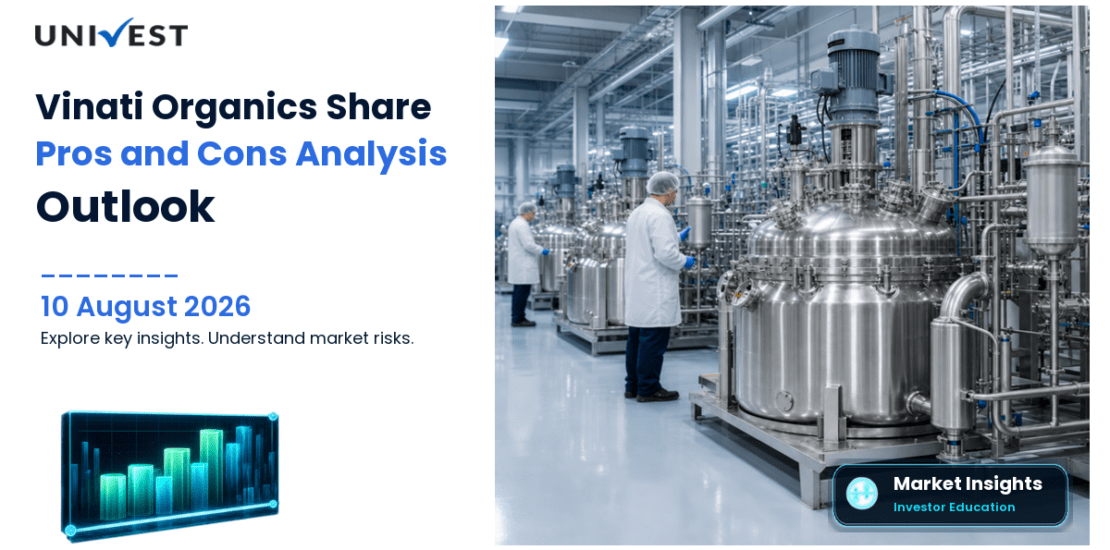
Vinati Organics share CMP approx Rs 1,331. 52-week high Rs 1,800, low Rs 1,100. Market Cap Rs 13,987 Cr. P/E ratio 31.19x.
Quick Answer
- Vinati Organics share at 31.19x PE with 14.03% ROE — global monopoly in ATBS (specialty acrylamide monomer) and IBB
- World’s largest producer of ATBS (used in oil field chemicals, water treatment) and IBB (ibuprofen intermediate)
- Key concern: ROE of 14.03% below quality benchmark for specialty chemical monopoly; capacity expansion compressing returns
Is the Vinati Organics share a good investment in 2026? This article provides a data-driven analysis of Vinati Organics share pros and cons — covering business strengths, valuation, growth drivers, and key risks — based on live data from 7 August 2026.
Click Here — Get Free Investment Predictions
About Vinati Organics
Vinati Organics Limited (NSE: VINATIORGA) is a Ratnagiri-based specialty chemicals company founded by Vinati Saraf Mutreja in 1989. It is the world’s largest manufacturer of 2-Acrylamido-2-Methylpropane Sulfonic Acid (ATBS) — used in oil field stimulation chemicals, water treatment polymers, and personal care ingredients — and Isobutyl Benzene (IBB) — used as an intermediate in ibuprofen synthesis. Both products have Vinati Organics as either the world’s only or one of two major global suppliers.
Key Financial Snapshot: Vinati Organics Share
| Parameter | Details |
|---|---|
| Company | Vinati Organics |
| NSE Symbol | VINATIORGA |
| Sector | Specialty Chemicals Export |
| CMP (Approx) | Rs 1,331 |
| 52-Week High | Rs 1,800 |
| 52-Week Low | Rs 1,100 |
| Market Cap | Rs 13,987 Cr |
| P/E Ratio | 31.19x |
Data approximate. Verify at nseindia.com.
Top 5 Pros of Vinati Organics Share
1. World’s Largest ATBS Producer — Near-Monopoly in Mission-Critical Chemical
Vinati Organics share’s primary competitive moat is global monopoly-level production of ATBS — a specialty acrylamide monomer used by oil field services companies (Schlumberger, Halliburton), water treatment chemical manufacturers, and personal care formulators. With virtually no viable substitute and very high entry barriers from process chemistry complexity, Vinati commands premium pricing that commodity chemical companies cannot achieve.
2. IBB Global Duopoly — Ibuprofen Intermediate With Limited Competition
Vinati Organics is one of two or three global manufacturers of IBB (Isobutyl Benzene) — the key intermediate for ibuprofen synthesis by global pharmaceutical companies. This duopoly position provides stable, premium-priced IBB revenue with high switching cost for pharmaceutical clients who have qualified Vinati’s IBB in their FDA-regulated synthesis processes.
3. Zero Debt Balance Sheet — Exceptional Capital Quality for Specialty Chemical Company
Vinati Organics maintains zero debt (debt-to-equity 0.00x) — unusual for a capital-intensive chemical manufacturing company. This reflects exceptional cash generation from the ATBS and IBB monopoly positions and conservative financial management.
4. ATBS End-Market Growth — Oil Field Chemicals and Water Treatment Expansion
Global oil field EOR (Enhanced Oil Recovery) spending and expanding municipal water treatment infrastructure in developing markets drive growing ATBS demand from oil field services and water treatment companies. Both end-markets are growing structurally.
5. New Products Beyond ATBS and IBB — Antioxidant Specialty Chemicals Diversifying
Vinati Organics is developing new specialty chemical products — including food antioxidants (BHA — Butylated Hydroxyanisole) and other oil soluble antioxidants — to reduce ATBS and IBB concentration risk and expand the specialty chemical portfolio.
Key Cons of Vinati Organics Share
1. ROE of 14.03 Percent Below Specialty Chemical Monopoly Quality Benchmark
At 14.03% ROE with zero debt, Vinati Organics share delivers below the 18 to 25 percent ROE expected from a genuine chemical monopoly business. This reflects ongoing capacity expansion investment that has temporarily increased capital employed without proportional revenue growth.
2. ATBS Capacity Expansion Revenue Recognition Lag — Temporary ROE Depression
Vinati Organics has been expanding ATBS manufacturing capacity that has increased capital employed significantly, while new capacity ramp-up takes time to generate commensurate revenue. This expansion phase temporarily depresses ROE and PE attractiveness.
3. Chinese Specialty Chemical Companies Building ATBS Capacity — Monopoly Risk
Several Chinese specialty chemical companies have announced ATBS manufacturing capacity — which if successfully scaled, could reduce Vinati’s near-monopoly pricing power and compress ATBS margins. Monitoring Chinese ATBS capacity commercialisation is the most critical risk factor for this stock.
4. PE of 31.19x Reasonably Justified But Requires ATBS Volume and New Product Growth
At 31.19x PE, Vinati Organics share requires consistent ATBS volume growth (from expanding capacity) and new product revenue to deliver adequate investor returns. Slower-than-expected capacity ramp-up or weaker-than-expected new product adoption would compress returns.
Use the Univest Screener to Analyse Stocks for Free
Is Vinati Organics Share a Good Investment in 2026?
Vinati Organics share is India’s finest specialty chemical monopoly investment — ATBS and IBB global leadership is genuinely rare. ROE recovery from capacity expansion normalisation is the primary catalyst. Chinese capacity competition is the key risk to monitor. Consider as quality specialty chemical core allocation.
Key Risks Before Buying Vinati Organics Share
- Chinese ATBS capacity successfully scaling and undercutting Vinati’s pricing significantly
- ATBS new capacity expansion taking longer than guided to reach full utilisation
- Oil field EOR spending decline from energy transition reducing ATBS end-market demand
- IBB pharmaceutical pricing pressure from ibuprofen commodity market competition
Conclusion
The Vinati Organics share offers world’s largest atbs producer — near-monopoly in mission-critical chemical as its primary investment case. Weigh it against roe of 14.03 percent below specialty chemical monopoly quality benchmark and the risks above before investing. Use the Univest Screener and consult a SEBI-registered advisor.
Download the Univest iOS App or Univest Android App to track Vinati Organics share price live.
Disclaimer: Data from publicly available sources. Approximate as of 7 Aug 2026. Verify on nseindia.com and bseindia.com. Not investment advice by Univest (SEBI RA INH000013776).
Frequently Asked Questions — Vinati Organics Share
What are the main pros of Vinati Organics share?
Ans. World’s largest ATBS producer with near-monopoly pricing, global IBB duopoly in ibuprofen intermediate, zero debt balance sheet with exceptional capital quality, ATBS oil field and water treatment end-market structural growth, and new specialty antioxidant products diversifying beyond ATBS and IBB concentration.
What are the risks of Vinati Organics share?
Ans. ROE of 14.03% below chemical monopoly quality benchmark, Chinese ATBS capacity building threatening monopoly pricing power, ATBS expansion revenue recognition lag depressing near-term ROE, and new product adoption pace uncertainty. Monitor Chinese ATBS plant commissioning news closely.
Is Vinati Organics share a good investment?
Ans. India’s finest specialty chemical monopoly at reasonable PE. Consider as quality specialty chemical core allocation. Consult a SEBI-registered advisor. Not investment advice.
What is the 52-week range of Vinati Organics share?
Ans. 52-week high approximately Rs 1,800, low Rs 1,100. Verify at nseindia.com.
What is ATBS and why does Vinati Organics have a global monopoly?
Ans. 2-Acrylamido-2-Methylpropane Sulfonic Acid (ATBS) is a specialty acrylamide-based sulfonic acid monomer used as a polymer building block in oil field stimulation fluids, water treatment flocculants, and superabsorbent polymers. The manufacturing process requires complex multi-step organic synthesis with stringent quality control that took Vinati Organics decades of process development to master. Vinati controls approximately 65 to 70 percent of global ATBS production capacity, making it the world’s largest and often sole viable supplier for quality-sensitive applications in the oil and gas industry.
What is IBB and why is Vinati the preferred supplier?
Ans. Isobutyl Benzene (IBB) is the primary intermediate for ibuprofen synthesis — used by global pharmaceutical companies (Boots, BASF, SI Group) to manufacture ibuprofen APIs. Because IBB must meet pharmaceutical-grade purity standards for FDA and EMA regulatory compliance, pharmaceutical customers qualify their specific supplier’s IBB in their FDA-approved manufacturing process. Once a pharmaceutical company’s FDA filing specifies Vinati’s IBB, switching to a different supplier requires expensive FDA re-validation — creating very high switching costs that make Vinati IBB customers extremely sticky.
