
Deepak Fertilisers and Petrochemicals Share: Pros and Cons Every Investor Must Know in 2026
- August 10, 2026
- Posted by: Neeraj Pandey
- Category: News
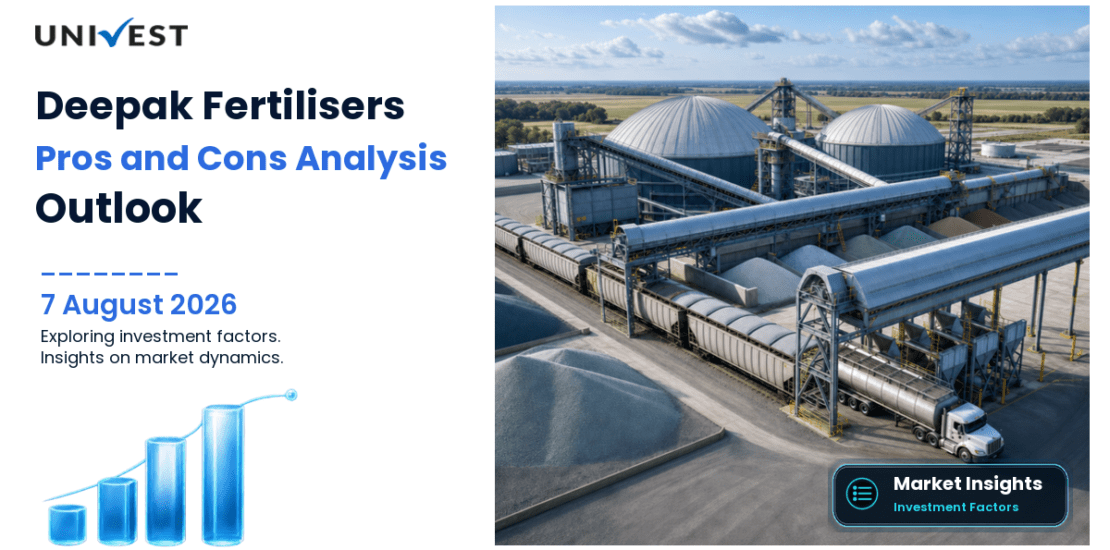
Deepak Fertilisers and Petrochemicals share CMP approx Rs 1,600. 52-week high Rs 2,100, low Rs 1,100. Market Cap Rs 7,200 Cr. P/E ratio 22.0x.
Quick Answer
- Deepak Fertilisers share at ~22x PE — India’s largest industrial chemicals (TAN, nitric acid) with fertilizer business
- Technical Ammonium Nitrate: India’s only indigenous TAN producer for mining and infrastructure blasting
- Key strength: TAN monopoly position in India — technical ammonium nitrate for mining explosives
Is the Deepak Fertilisers and Petrochemicals share a good investment in 2026? This article provides a data-driven analysis of Deepak Fertilisers and Petrochemicals share pros and cons — covering business strengths, valuation, growth drivers, and key risks — based on live data from 7 August 2026.
Click Here — Get Free Investment Predictions
About Deepak Fertilisers and Petrochemicals
Deepak Fertilisers and Petrochemicals Corporation Limited (NSE: DEEPAKFERT) is a Pune-based diversified chemicals and fertilizers company founded in 1979. India’s largest Technical Ammonium Nitrate (TAN) producer — TAN is used in mining explosives and construction blasting — it also produces ammonia, methanol, nitric acid, ammonium nitrate, and agricultural fertilizers including MAHADHAN brand NPK fertilizers. Deepak Fertilisers is the only Indian company that independently produces TAN — a strategic national defence and mining input.
Key Financial Snapshot: Deepak Fertilisers and Petrochemicals Share
| Parameter | Details |
|---|---|
| Company | Deepak Fertilisers and Petrochemicals |
| NSE Symbol | DEEPAKFERT |
| Sector | Fertilizers and Chemicals |
| CMP (Approx) | Rs 1,600 |
| 52-Week High | Rs 2,100 |
| 52-Week Low | Rs 1,100 |
| Market Cap | Rs 7,200 Cr |
| P/E Ratio | 22.0x |
Data approximate. Verify at nseindia.com.
Top 5 Pros of Deepak Fertilisers and Petrochemicals Share
1. Technical Ammonium Nitrate Monopoly — India’s Only Indigenous TAN Producer
Deepak Fertilisers share benefits from India’s sole indigenous TAN (Technical Ammonium Nitrate) production capability. TAN is the primary raw material for commercial explosives (ANFO — Ammonium Nitrate Fuel Oil) used in coal mining, iron ore mining, limestone quarrying, and construction blasting. As India’s mining activity grows for coal (power and steel), iron ore, and limestone (cement), TAN demand grows proportionally.
2. Nitric Acid Leadership — Industrial Chemical for Nylon, Explosives, and Agrochemicals
Deepak Fertilisers is India’s largest nitric acid producer — supplying this versatile industrial chemical to explosive manufacturers, nylon fibre producers (Nylon-6, Nylon-66), pharmaceutical and agrochemical companies. Nitric acid demand grows with India’s chemical industry expansion.
3. MAHADHAN Fertilizers Brand — Maharashtra’s Most Recognised NPK Fertilizer
MAHADHAN is one of Maharashtra’s most recognised branded complex NPK fertilizer brands — providing agricultural revenue that partially offsets the industrial chemicals cyclicality. Maharashtra’s large agricultural market provides recurring fertilizer demand.
4. Mining Sector Growth Tailwind — Coal and Iron Ore Mining Expanding
India’s coal mining (targeting 1.5 billion tonnes annually), iron ore mining for steel (targeting 400 million tonnes), and limestone quarrying for cement (targeting 600 million tonnes) are all expanding — creating growing demand for TAN and commercial explosives that only Deepak Fertilisers supplies indigenously.
5. Reasonable PE of Approximately 22x — Chemical Company With Monopoly Position
At approximately 22x PE, Deepak Fertilisers share is reasonably priced for an industrial chemical company with TAN monopoly position in India’s growing mining market.
Key Cons of Deepak Fertilisers and Petrochemicals Share
1. Commodity Chemical Price Cyclicality — Ammonia and Natural Gas Input Cost Volatility
Deepak Fertilisers’ primary inputs — natural gas (for ammonia production) and liquid ammonia (for nitric acid and TAN) — are commodities with significant international price volatility. Natural gas price spikes in 2022-23 severely impacted ammonia and fertilizer manufacturers globally — compressing margins sharply.
2. Fertilizer Subsidy Dependency — Government Subsidy Payment Delays Impacting Cash Flow
Deepak Fertilisers’ agricultural fertilizer business depends on government subsidy payments for phosphatic and complex fertilizers. Delays in government subsidy payments create working capital stress — a recurring challenge for India’s fertilizer companies.
3. TAN Market Growth Limited by Regulatory Environment — Ammonium Nitrate Controls
India’s ammonium nitrate regulations (from security concerns about explosive precursor chemicals) create constraints on TAN production expansion, storage, and distribution — limiting the pace at which Deepak Fertilisers can grow TAN supply even as mining demand grows.
4. Competition From Imported TAN in Some Mining Circles
International TAN imports (from Middle East, Russia, and Eastern Europe) compete with Deepak Fertilisers in some mining states where coastal proximity makes import freight economics competitive — limiting complete pricing power in coastal mining geographies.
Use the Univest Screener to Analyse Stocks for Free
Is Deepak Fertilisers and Petrochemicals Share a Good Investment in 2026?
Deepak Fertilisers share is India’s most strategically unique chemical investment — TAN monopoly and nitric acid leadership at reasonable PE. Natural gas input cyclicality and fertilizer subsidy dependency are the structural constraints. Consider as a quality specialty chemicals and fertilizers allocation.
Key Risks Before Buying Deepak Fertilisers and Petrochemicals Share
- Natural gas price spike increasing ammonia production cost and compressing TAN margins
- Government fertilizer subsidy payment delays increasing working capital requirements
- TAN import competition from Middle East reducing Deepak’s domestic pricing power
- Mining activity slowdown from India’s coal import policy changes reducing TAN demand
Conclusion
The Deepak Fertilisers and Petrochemicals share offers technical ammonium nitrate monopoly — india’s only indigenous tan producer as its primary investment case. Weigh it against commodity chemical price cyclicality — ammonia and natural gas input cost volatility and the risks above before investing. Use the Univest Screener and consult a SEBI-registered advisor.
Download the Univest iOS App or Univest Android App to track Deepak Fertilisers and Petrochemicals share price live.
Disclaimer: Data from publicly available sources. Approximate as of 7 Aug 2026. Verify on nseindia.com and bseindia.com. Not investment advice by Univest (SEBI RA INH000013776).
Frequently Asked Questions — Deepak Fertilisers and Petrochemicals Share
What are the main pros of Deepak Fertilisers share?
Ans. India’s only indigenous TAN producer with mining explosives monopoly, nitric acid leadership for industrial chemical customers, MAHADHAN fertilizer brand in Maharashtra agriculture, mining sector expansion in coal, iron ore, and limestone creating growing TAN demand, and reasonable PE of approximately 22x for chemical company with monopoly TAN position.
What are the risks?
Ans. Natural gas and ammonia commodity price cyclicality, government fertilizer subsidy payment delays creating working capital stress, TAN regulatory constraints limiting production expansion pace, and imported TAN competition in coastal mining areas. Monitor quarterly natural gas prices and TAN order book.
Is Deepak Fertilisers share a good investment?
Ans. India’s unique TAN monopoly and nitric acid leader at reasonable PE. Consider as quality specialty chemicals allocation. Consult a SEBI-registered advisor. Not investment advice.
What is the 52-week range?
Ans. 52-week high approximately Rs 2,100, low Rs 1,100. Current Rs 1,600. Verify at nseindia.com.
What is Technical Ammonium Nitrate (TAN) and why does India import most of it?
Ans. Technical Ammonium Nitrate (TAN) is a high-purity form of ammonium nitrate used exclusively as the explosive component in commercial blasting — mixed with fuel oil (ANFO) or emulsified with water (emulsion explosives) for use in coal mines, iron ore quarries, and construction blasting. India currently produces TAN only at Deepak Fertilisers’ Taloja plant (Maharashtra) — meeting only 15-20% of India’s mining TAN demand. The remaining 80-85% is imported, primarily from Russia, Middle East, and Norway. This import dependency makes India’s mining explosives strategically vulnerable to supply disruptions and currency fluctuations — creating the case for expanding indigenous TAN production.
What is Deepak Fertilisers’ MAHADHAN brand?
Ans. MAHADHAN is Deepak Fertilisers’ branded complex fertilizer range for Maharashtra’s agriculture — covering NPK (Nitrogen-Phosphorus-Potassium) granulated fertilizers in specific ratios for different crops (cotton, sugarcane, soybean, onion), water-soluble fertilizers for drip irrigation, and specialty crop nutrition products. MAHADHAN is one of Maharashtra’s highest-selling fertilizer brands — distributed through agricultural dealers across all Maharashtra districts. The brand provides Deepak Fertilisers with agricultural revenue that is partially counter-cyclical to industrial chemical demand.
