
Is National Fertilizers a Good Buy After Its Q1 FY27 Results?
- September 4, 2026
- Posted by: Kunal Singla
- Category: Market
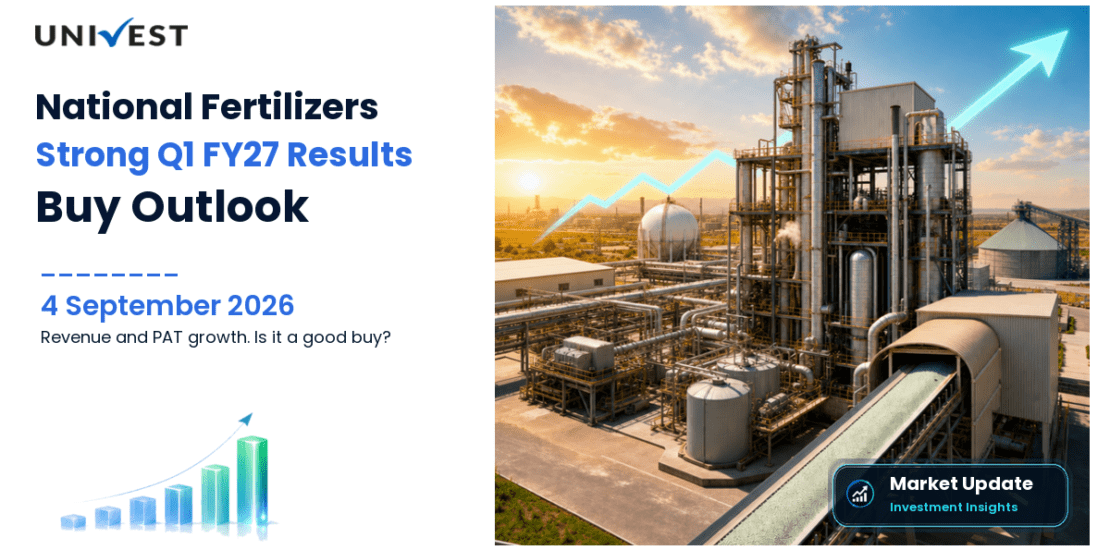
National Fertilizers share price around Rs 71. 31.3% below 52-week high of Rs 103. Q1 FY27 revenue Rs 4,512 crore, up 27.3% YoY. PAT Rs 113 crore, up 387.5%. PE 9x.
Quick Answer
National Fertilizers’ Q1 FY27 results were strong, with revenue at Rs 4,512 crore and swinging from a loss of Rs 39 crore a year earlier to a profit of Rs 113 crore this quarter. The stock trades at a PE of 9x against an industry average near 23x, which leaves room for a re-rating if this growth continues. The National Fertilizers share price near Rs 71 reflects that optimism, so investors weighing whether National Fertilizers is a good buy today should focus on whether this pace of growth can be sustained rather than just this quarter’s print.
The National Fertilizers share price has been under the spotlight this results season after the company reported its first-quarter numbers for FY27. National Fertilizers is a government-owned nitrogenous fertilizer manufacturer, and its Q1 FY27 print, for the quarter ended June 30, 2026, gives investors a fresh data point to test whether the stock still deserves a place in a portfolio at current levels.
Revenue for the quarter came in at Rs 4,512 crore, up 27.3% year on year, while profit after tax came in at Rs 113 crore, up 387.5% from a year earlier. That combination of numbers is exactly what this article breaks down, along with what it means for the National Fertilizers share price from here.
This piece works through the quarter’s financial highlights, the business factors behind the numbers, where the National Fertilizers share price stands against its 52-week range and valuation multiples, and the key risks worth watching before treating this as a buy, hold or a stock to avoid for now.
Click Here – Get Free Investment Predictions
National Fertilizers Q1 FY27 Financial Highlights
| Metric | Q1 FY27 | Q1 FY26 | YoY Change |
|---|---|---|---|
| Revenue | Rs 4,512 crore | Rs 3,543 crore | 27.3% |
| EBITDA | Rs 278 crore | Rs 98 crore | 185.3% |
| Operating Margin | 7.1% | 2.5% | NA |
| Profit Before Tax | Rs 138 crore | -Rs 52 crore | 364.6% |
| Net Profit / (Loss) | Rs 113 crore | -Rs 39 crore | 387.5% |
National Fertilizers Q1 FY27 Performance Analysis
Check National Fertilizers Fundamentals on Univest Screener
Revenue growth of 27.3% for the quarter came from steady demand across the company’s core business, keeping the topline trend intact for the nitrogenous fertilizer production sector.
The bigger story is the swing back to profit. National Fertilizers posted a loss of Rs 39 crore in the year-ago quarter and turned that into a profit of Rs 113 crore this time, a genuine turnaround rather than just faster growth off an already-profitable base. This is the kind of quarter that supports the premium the National Fertilizers share price already commands, though investors should check whether the turnaround is durable or helped by one-off factors.
On a sequential basis, revenue moved up 3.5% sequentially from Rs 4,359 crore in the March 2026 quarter and net profit moved down 25.2% sequentially from Rs 152 crore in the prior quarter, giving a fuller picture of the trend behind the National Fertilizers share price than the year on year comparison alone.
Key Business Factors in Q1 FY27
Revenue Trend
National Fertilizers’ revenue grew 27.3% year on year this quarter, taking the quarterly base to Rs 4,512 crore in a nitrogenous fertilizer production business that remains sensitive to demand and pricing cycles that ultimately feed through to the National Fertilizers share price.
Margin Movement
EBITDA rose 185.3% to Rs 278 crore, and operating margin moved to 7.1% from 2.5% a year earlier, a sign that cost control or pricing held up during the quarter.
Balance Sheet Position
National Fertilizers’ debt-to-equity ratio stands at 1.40, a level worth monitoring given the quarter’s margin trend.
Valuation Context
The stock trades at a PE of 9.4x, below the industry average of 23.2x, which is worth factoring into any read of whether the National Fertilizers share price is expensive or reasonably priced.
Dividend Details
No interim dividend was declared alongside National Fertilizers’ Q1 FY27 results. The stock currently carries a trailing dividend yield of 1.48%, based on dividends paid over the last year. Investors tracking the National Fertilizers share price for income should watch the company’s announcements around its next annual results for any dividend decision.
National Fertilizers Share Price Outlook for FY27
The Q1 FY27 print sets a reasonably high bar for the rest of the year. If National Fertilizers can sustain this pace of revenue and profit growth, the current valuation gets easier to justify. The main swing factor is whether this quarter’s momentum reflects a durable trend or a favourable one-off, something the next two quarters should clarify.
For the National Fertilizers share price to hold its current premium through FY27, the company will likely need to keep posting growth at or near this quarter’s pace, since any slowdown would put pressure on a stock priced for continued strength.
National Fertilizers Stock Performance
Download the Univest iOS App or Univest Android App to track National Fertilizers’ live share price and get daily stock updates.
The National Fertilizers share price was trading around Rs 71 as results season played out in late August 2026, roughly 31.3% below its 52-week high of Rs 103 and well above its 52-week low of Rs 63. Promoter holding stood at 74.7% as of the June 2026 quarter.
The National Fertilizers share price has room to re-rate further if the growth shown this quarter continues, though much of the good news may already be reflected in the stock near current levels. On profitability ratios, the company reports a return on equity of 7.44% and a book value of around Rs 58 per share, both useful reference points when judging whether the current price is reasonable.
Key Risks
Leverage Risk
A debt-to-equity ratio of 1.40 means the company’s earnings are more sensitive to interest rate and refinancing conditions than a lower-debt peer.
Sector and Demand Risk
As a nitrogenous fertilizer production business, National Fertilizers’ results remain tied to sector-specific demand, pricing and regulatory cycles that can shift from quarter to quarter and move the National Fertilizers share price well before the next result.
Execution Risk
Sustaining this quarter’s trend into the rest of FY27 depends on management execution on costs, pricing and demand, none of which are guaranteed.
Conclusion
National Fertilizers’ Q1 FY27 results were genuinely strong, with revenue at Rs 4,512 crore and PAT up 387% to Rs 113 crore. That said, at a PE of 9.4x, the National Fertilizers share price is not inexpensive, so this looks like a quality business trading at a full price rather than a bargain. Existing investors have little to worry about from this print, while new investors asking whether National Fertilizers is a good buy should weigh the strong quarter against the valuation before adding at current levels.
Disclaimer: Data and figures in this article are sourced from publicly available information. These may or may not be accurate. Please verify all data with the official NSE (nseindia.com) and BSE (bseindia.com) websites before making any investment decision. Investments in securities are subject to market risk. This content is for educational purposes only and is not investment advice by Univest (SEBI RA INH000013776).
Frequently Asked Questions on National Fertilizers Q1 FY27 Results
What were National Fertilizers’ Q1 FY27 results?
Ans. National Fertilizers reported Q1 FY27 revenue of Rs 4,512 crore, up 27.3% year on year, and PAT of Rs 113 crore, up 387.5% year on year.
Is National Fertilizers a good buy after its Q1 FY27 results?
Ans. National Fertilizers’ core numbers improved this quarter, though at a PE of 9.4x the stock is not inexpensive, so this suits investors comfortable paying up for quality. Investors should form their own view based on their own risk appetite and time horizon.
What is the National Fertilizers share price today?
Ans. The National Fertilizers share price was trading around Rs 71 in late August 2026, about 31.3% below its 52-week high of Rs 103 and well above its 52-week low of Rs 63.
What is National Fertilizers’ revenue and profit for Q1 FY27?
Ans. National Fertilizers reported revenue of Rs 4,512 crore and a net profit of Rs 113 crore for the quarter ended June 30, 2026.
Did National Fertilizers declare a dividend with its Q1 FY27 results?
Ans. No interim dividend was declared alongside National Fertilizers’ Q1 FY27 results. Investors should track the company’s next annual results for any dividend announcement.
What is National Fertilizers’ PE ratio and is it expensive?
Ans. The National Fertilizers share price trades at a trailing PE of 9.4x, against an industry average of 23.2x. Investors should compare this with the company’s growth rate before judging value.
What are the key risks for National Fertilizers investors right now?
Ans. A debt-to-equity ratio of 1.40 means the company’s earnings are more sensitive to interest rate and refinancing conditions than a lower-debt peer. Sustaining this quarter’s trend into the rest of FY27 depends on management execution on costs, pricing and demand, none of which are guaranteed.
What is National Fertilizers’ promoter shareholding?
Ans. Promoter holding in National Fertilizers stood at 74.7% as of the June 2026 quarter.
