
US-Iran Peace Deal to Be Signed on Friday, June 19 in Switzerland: Everything We Know and What It Means for Indian Stock Markets
- June 15, 2026
- Posted by: Ankit Jaiswal
- Category: News
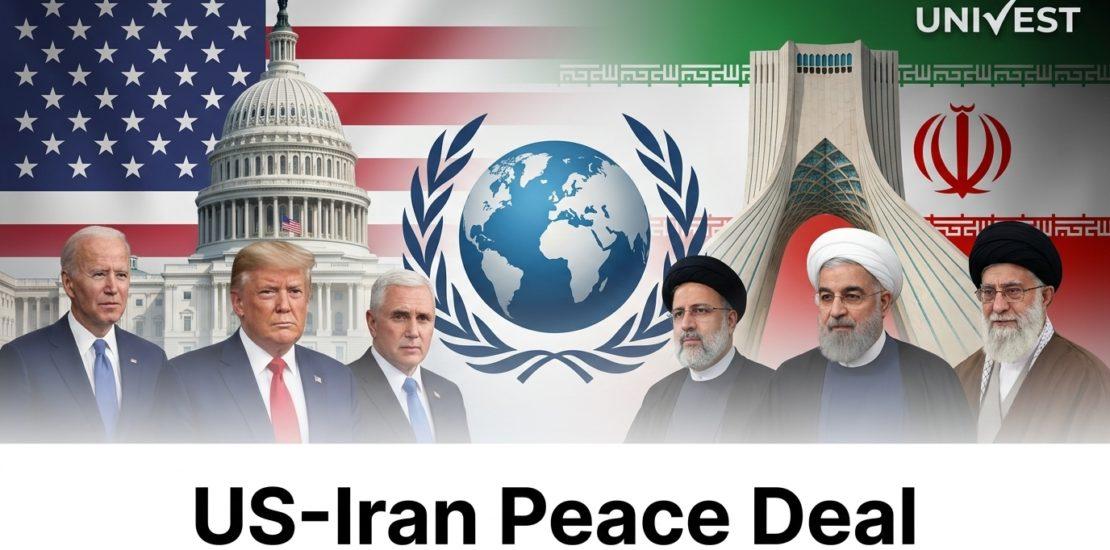
US-Iran peace deal CONFIRMED (June 14, 2026): Announced by Pakistan PM Sharif + Trump (Truth Social). Official signing: Friday June 19, 2026, Switzerland. Key terms: Immediate permanent ceasefire + Strait of Hormuz toll-free opening + US Naval blockade removed. Market reaction (June 12 signal): Nifty +1.22% | IndiGo +3.40% | BPCL +2.76% | ONGC -3.29%. Crude oil: Down 3-5% on signal; further fall to $75-80 expected.
The Iran peace deal between the United States and Iran has been confirmed, with Pakistan Prime Minister Shehbaz Sharif announcing on June 14, 2026 that “the Peace Deal between the United States of America and Islamic Republic of Iran has been REACHED.” US President Donald Trump confirmed on Truth Social: “The Deal with the Islamic Republic of Iran is now complete. I hereby fully authorize the toll free opening of the Strait of Hormuz, and, simultaneously herewith, authorize the immediate removal of the United States Naval blockade. Ships of the World, start your engines. Let the oil flow!” The official signing ceremony for the Iran peace deal is scheduled for Friday, June 19, 2026 in Switzerland. For Indian investors, this is the single most important geopolitical event of 2026 because India imports approximately 85-88% of its crude oil needs, and the Strait of Hormuz is the primary transit route for that supply. The reopening of Hormuz, the end of the US Naval blockade, and the prospect of Brent crude falling from $90+ toward $75-80 creates a cascading positive effect across airline stocks, oil marketing companies, tyre manufacturers, chemical producers, consumer companies, banks, and infrastructure firms while simultaneously hurting upstream oil producers.
Click Here – Get Free Research From Univest
Iran Peace Deal: Full Timeline From War to Wednesday Peace
| Date | Event | Market Impact |
|---|---|---|
| Feb 28, 2026 | US and Israel launch coordinated strikes on Iran; war begins | Brent crude surges past $100; Nifty fell 4-5%; ONGC, OIL surged; airlines crashed |
| April 7, 2026 | Pakistan-brokered two-week ceasefire announced; Strait of Hormuz partially reopens | Crude fell 8-10% on ceasefire day; Nifty recovered 2-3%; IndiGo, BPCL rallied |
| April 8-12, 2026 | Islamabad talks; ceasefire holds but remains fragile | Crude stabilised at $90-100; volatility elevated |
| April-May 2026 | Ceasefire fragile; cross-border strikes continue; Lebanon fighting ongoing | Crude elevated $93-110; Indian inflation rose; RBI delayed rate cuts |
| June 12, 2026 | Trump signals ‘great settlement with Iran’; Brent falls below $90 | Nifty +1.22%; IndiGo +3.40%; BPCL +2.76%; ONGC -3.29% |
| June 14, 2026 (Sunday) | Deal CONFIRMED: Pakistan PM + Trump announce permanent ceasefire; Hormuz fully reopens | Global oil futures fall 3-5%; S&P 500 futures +0.6%; Nifty Monday gap-up expected |
| June 15, 2026 (Today) | Indian markets open with full deal confirmation priced in | Expected: Nifty +1.5-2.5%; IndiGo +5-8%; BPCL +4-6%; ONGC -5-7% |
| June 19, 2026 (Friday) | Official signing ceremony in Switzerland; deal formalised | Expected: Crude further falls toward $75-80; sustained rally in oil-sensitive stocks |
Track Iran Deal Market Impact Live on Univest
Univest covers all Iran deal beneficiary stocks with live prices and sector research.
- Live price tracking for all Iran deal winners: IndiGo, BPCL, L&T, Apollo Tyres
- Crude oil and market impact daily analysis from Univest analysts
- Sector-wise Iran deal impact guide with entry zones and targets
Iran Peace Deal: Key Terms Explained
| Deal Element | Details | India Relevance |
|---|---|---|
| Immediate ceasefire | Permanent termination of military operations on all fronts incl. Lebanon | War risk premium in crude oil permanently deflates |
| Strait of Hormuz | Immediate toll-free opening ordered by Trump | India’s primary oil shipping route fully restored; import cost falls |
| US Naval blockade | Immediate removal | Global oil supply normalises; crude falls toward pre-war levels |
| Mediators | Pakistan (primary), Qatar, Saudi Arabia, Turkey | India’s diplomatic ties with Pakistan and Gulf remain important |
| Israel position | NOT a party to the deal; Netanyahu confirmed exclusion | Risk: Israel may take independent action; deal fragility concern |
| Iran confirmation | Deputy FM Gharibabadi confirmed | Both sides committed = deal credibility high |
| Pre-implementation | Talks this week before June 19 signing | Technical implementation of Hormuz reopening and blockade removal |
| Signing ceremony | Friday June 19, 2026 in Switzerland | Definitive market catalyst date |
| Nuclear issue | Deal does NOT include Iran’s nuclear programme (unresolved) | Long-term risk remains; possible future escalation |
| UN endorsement | UN Secretary-General Guterres called it a permanent ceasefire | International legitimacy; FPI inflows into India improve |
Why the Strait of Hormuz Reopening Is a Game-Changer
The Strait of Hormuz is the world’s most strategically critical oil chokepoint. Approximately 20-21 million barrels per day of crude oil, condensate, and LNG pass through this narrow waterway between Iran and Oman, representing roughly 20% of global seaborne oil trade. When the US-Israeli strikes on Iran began on February 28, 2026 and the Iranian military responded with attacks on Gulf shipping, the effective closure of the Strait pushed Brent crude from approximately $70-75 per barrel to above $100. With the Iran peace deal ordering “immediate and permanent” Hormuz reopening, the 20+ mbpd of oil supply that has been disrupted will return to global markets. This supply surge will push Brent crude toward $75-80 over 3-6 months. Each $10 fall in Brent saves India approximately Rs 1.5-2 lakh crore annually in import costs, reducing the trade deficit, strengthening the rupee, and moderating domestic inflation.
How the Iran Peace Deal Changes the RBI Rate Cut Calculus
The Iran peace deal fundamentally improves the outlook for RBI rate cuts in H2 FY27. The war had elevated Brent crude to $90-110 range, pushing India’s retail inflation from 3.21% in March to 3.93% in May 2026 (just 7 basis points below the RBI’s 4% target). With the Hormuz fully open and crude expected to fall toward $75-80 over the next quarter, transport inflation (which reversed from -0.01% in April to +4.15% in May) should fall sharply in June-August 2026. India’s CPI inflation should moderate back to the 3.0-3.5% range by Q3 FY27, comfortably below the 4% target. This creates clear headroom for 25-50 basis points of RBI rate cuts in the August or October 2026 MPC meetings, the largest positive catalyst for banks, NBFCs, real estate, and consumer stocks.
What Happens Between Now and the June 19 Signing
In the period between the Iran peace deal announcement (June 14) and the official signing in Switzerland (June 19), pre-implementation technical discussions are underway. These will cover: the sequencing of US Naval blockade removal and Hormuz reopening, the specifics of ceasefire monitoring and violation response mechanisms, the timeline for Iran reducing its enrichment activities, and the framework for follow-on comprehensive agreement negotiations. Investor risk: Israel is NOT a party to the deal. Netanyahu has confirmed Israel will not be bound by terms that permit Iran to acquire nuclear weapons. If Israel launches strikes on Iranian nuclear facilities before June 19, the deal could be jeopardised. This is the key tail risk investors must monitor through the Iran peace deal signing date.
Track Iran Deal Stocks and Crude Oil Impact on Univest
Conclusion
The Iran peace deal confirmed on June 14, 2026 and to be signed on Friday June 19 in Switzerland is the most significant geopolitical and economic event for Indian markets in 2026. The immediate benefits: Strait of Hormuz fully open, crude oil heading toward $75-80, India’s import bill falling, inflation moderating, RBI rate cuts unlocked, rupee strengthening. Key winners: IndiGo, BPCL, IOC, HPCL, Apollo Tyres, L&T, HDFC Bank, Canara Bank, Asian Paints. Key losers: ONGC, Oil India, gold. The key risk: Israel acting independently. Track all Iran peace deal market developments on Univest.
Download the Univest iOS App or Univest Android App to track all Iran peace deal stock moves and crude oil impact live on Univest.
Disclaimer: Data and figures in this article are sourced from publicly available information. These may or may not be accurate. Please verify all data with the official NSE (nseindia.com) and BSE (bseindia.com) websites before making any investment decision. Geopolitical developments are inherently uncertain. Investments in securities are subject to market risk. This content is for educational purposes only and is not investment advice by Univest (SEBI RA INH000013776).
Frequently Asked Questions
What are the key terms of the US-Iran peace deal announced June 14, 2026?
Ans. The US-Iran peace deal announced on June 14, 2026 includes: immediate and permanent termination of military operations on all fronts, including in Lebanon; toll-free opening of the Strait of Hormuz ordered by President Trump immediately; immediate removal of the US Naval blockade; Iran confirmation through Deputy Foreign Minister Kazem Gharibabadi; and an official signing ceremony scheduled for Friday, June 19, 2026 in Switzerland. The deal was mediated by Pakistan (primary), with contributions from Qatar, Saudi Arabia, and Turkey. Israel is NOT a party to this deal. The UN Secretary-General congratulated both sides. Pre-implementation technical discussions are ongoing this week before the formal signing.
How will the Iran peace deal affect Brent crude oil prices and India?
Ans. The Iran peace deal has two direct impacts on Brent crude oil: First, the Strait of Hormuz reopening restores approximately 20-21 million barrels per day (mbpd) of oil and LNG transit that was disrupted during the war, representing roughly 20% of global seaborne oil trade. This supply surge will push Brent crude from the current $89-90 range toward $75-80 over the next 3-6 months as the market rebalances. For India, which imports approximately 85-88% of its crude needs, this is enormously positive. Each $10 fall in Brent crude saves India approximately $15-20 billion annually in the import bill, reducing the trade deficit, strengthening the rupee, and lowering domestic inflation. This creates the conditions for the RBI to deliver more aggressive rate cuts in H2 FY27.
Which Indian stocks benefit the most from the Iran peace deal?
Ans. The biggest winners in India from the Iran peace deal are aviation stocks and downstream oil companies. IndiGo is the highest-conviction winner: Aviation Turbine Fuel (ATF) accounts for 35-40% of IndiGo’s operating costs, and a 20% fall in Brent crude reduces ATF costs by a similar proportion, saving IndiGo approximately Rs 2,000-2,500 crore per quarter in fuel expenses. This flows directly to EBITDA. BPCL, IOC, and Hindustan Petroleum benefit as refiners through improved gross refinery margins when input crude costs fall. Tyre companies (Apollo, CEAT, MRF) benefit through lower synthetic rubber and carbon black costs. L&T benefits from potential Gulf infrastructure project restart as Saudi Arabia and UAE resume long-delayed projects. Banks and NBFCs (HDFC Bank, Canara Bank) benefit indirectly through lower inflation enabling RBI rate cuts.
What are the risks that could derail the Iran peace deal?
Ans. Several risks could derail or complicate the Iran peace deal. First, Israel’s exclusion: Israel is NOT a party to the deal and has stated that it will not permit Iran to obtain nuclear weapons. If Israel takes unilateral military action against Iran’s nuclear facilities, the deal could collapse. Second, implementation risks: Pre-implementation technical discussions are underway before the June 19 signing; if either side violates the ceasefire during this period, the deal could break down, as the April 7 ceasefire did. Third, Iran’s domestic politics: Iran’s Supreme National Security Council said US commitments must be met before final negotiations begin, creating a sequencing challenge. Fourth, nuclear issue unresolved: The deal does NOT address Iran’s nuclear programme, leaving the fundamental strategic conflict between the US/Israel and Iran unresolved. Fifth, the deal is a Memorandum of Understanding (MOU), not a final comprehensive agreement, which leaves many details to future negotiations.
