
Fed Rate Hike Under Kevin Warsh: US Fed Lifts Rates 25 bps to 3.75%-4% on 16 September 2026, Signals More Hikes as Rupee Tests 96
- September 17, 2026
- Posted by: Harsh Piplani
- Category: News
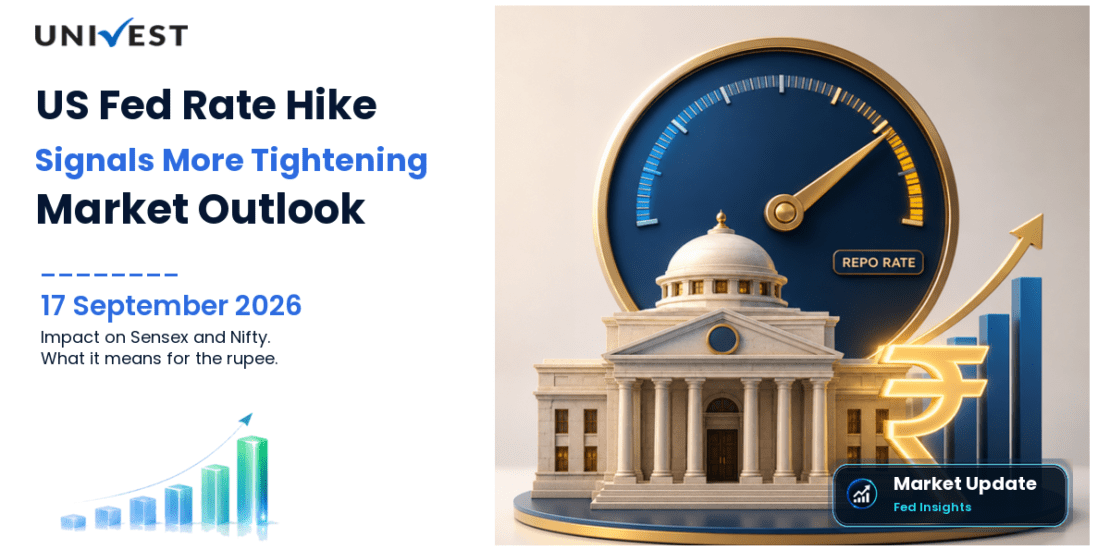
Fed lifts rates 25 bps to 3.75%-4% on 16 Sep 2026. Vote 12-0. First hike since July 2023. Nifty 23,268.95, up 0.22% at 11 AM, 17 Sep. Rupee near 96 per dollar.
Quick Answer
The Fed rate hike announced on 16 September 2026 lifted the US benchmark rate by 25 basis points to a range of 3.75% to 4%, the first increase since July 2023 and the first under Chair Kevin Warsh. The decision was unanimous at 12-0, and 16 of 18 policymakers now expect at least one more increase before the year ends. Indian equities held steady on 17 September, with the Nifty 50 up 0.22% by late morning, while the rupee traded close to 96 per dollar. The larger risk for India is continued foreign selling if US Treasury yields stay above 5%.
The Fed rate hike on Wednesday, 16 September 2026, ends a three-year pause in US monetary tightening and puts Kevin Warsh’s Federal Reserve firmly on the inflation-fighting side. The Federal Open Market Committee (FOMC) raised the federal funds rate by a quarter point to 3.75%-4%, after leaving it untouched at its first five meetings of the year.
For Indian investors, this Fed hike matters less for its size and more for its signal. The Fed has pencilled in more tightening, US 10-year yields have crossed 5%, and the rupee is testing 96 per dollar. Here is what the Fed announced, why it moved now, and how the move is playing out on Dalal Street.
Click Here – Get Free Investment Predictions
What Did the Fed Announce on 16 September 2026?
The Federal Reserve raised its policy rate by 25 basis points to a target range of 3.75% to 4%, with all 12 voting members backing the Fed rate hike. The last increase came in July 2023, when the Jerome Powell-led Fed wrapped up its post-pandemic tightening cycle.
In its statement, the FOMC said economic activity is expanding at a solid pace and that inflation remains elevated. The committee described the hike as a step toward a quicker return to its 2% inflation goal. The key numbers from the meeting are below.
| Parameter | Details |
|---|---|
| Decision date | 16 September 2026 |
| Rate action | Hike of 25 basis points |
| New federal funds rate | 3.75% to 4% |
| Previous range | 3.50% to 3.75% |
| Vote | 12-0, unanimous |
| Last hike before this | July 2023 |
| Officials expecting at least one more 2026 hike | 16 of 18 |
| Remaining 2026 FOMC meetings | October and December |
Markets had largely priced in the Fed rate hike after hot inflation readings and Warsh’s own comments in the weeks before the meeting, so the surprise element lay in the forward projections rather than the hike itself.
Why Did Kevin Warsh’s Fed Raise Interest Rates Now?
Kevin Warsh’s Fed raised rates because inflation has stayed above target for too long, pushed higher by an energy shock linked to the US-Iran conflict. At his press conference, Warsh said the committee needs clear evidence that underlying inflation is falling toward 2% at a sufficient pace, and that this test had not been met.
A strong economy gave the Fed room to act. With the US Fed interest rate now at 3.75%-4%, borrowing costs are back above where they started the year. Officials noted resilient domestic spending, robust capital investment and job gains that have kept pace with the workforce. The updated projections see US GDP growing 2.3% in 2026 and 2.4% in 2027, both slightly above the June estimates.
Politics adds another layer. The US interest rate increase came weeks before the midterm elections and despite repeated public calls from President Donald Trump for lower borrowing costs. Trump later said he still has confidence in Warsh, but argued that rates are too high.
Dot Plot Signals More Fed Rate Hikes Before December
The dot plot shows most policymakers expect another Fed rate hike this year. Of the 18 participants who submitted projections, 16 see at least one more quarter-point move in 2026, and four of them see room for two. Only two officials expect the committee to stop after this single increase.
Warsh has not submitted a dot since becoming chair, which leaves 18 projections instead of 19. The projections show no further hikes in 2027, with rate cuts pencilled in for 2028 and 2029. Put simply, the Fed is signalling a short, sharp tightening phase rather than a long cycle like the one that ran from 2022 to 2023.
That puts the October and December FOMC meetings at the centre of global market attention. A second Fed rate hike in either meeting would keep the dollar firm and US yields elevated, which is the transmission channel that matters most for India.
How Wall Street and Bond Markets Reacted to the Fed Rate Hike
US stocks turned lower as Warsh spoke. The Dow Jones Industrial Average lost around 650 points, or about 1.25%, late in the session, while the S&P 500 swung between gains and losses before slipping into the red. A 4% fall in Goldman Sachs added to the Dow’s losses.
The bond market sent a sharper message after the Fed hike. The US 10-year Treasury yield climbed above 5% to 5.016%, and the 2-year yield rose more than 7 basis points to 4.738%. The US dollar index traded around 100.23 on Thursday morning. By then, US stock futures were pointing to a modest recovery.
Fed Rate Hike Impact on India: Sensex, Nifty and Rupee
The Fed rate hike impact on India was muted at the open. Any change in the US Fed interest rate reaches Indian markets through three channels: the dollar, bond yields and foreign flows. Both benchmarks started Thursday’s session with a gap-down, but buying at lower levels pulled them back into positive territory within the first hour. Broader indices outperformed, while IT and banking stocks lagged.
| Index | Level (11:00 AM, 17 Sep) | Change | Previous Close |
|---|---|---|---|
| Nifty 50 | 23,268.95 | +51.35 (+0.22%) | 23,217.60 |
| Sensex | 74,415.01 | +78.56 (+0.11%) | 74,336.45 |
| Bank Nifty | 56,242.15 | -50.30 (-0.09%) | 56,292.45 |
| Nifty IT | 28,868.70 | -218.95 (-0.75%) | 29,087.65 |
| Nifty Midcap 50 | 17,700.35 | +140.25 (+0.80%) | 17,560.10 |
The Sensex opened at 74,182.62 and the Nifty 50 at 23,195.25, both below Wednesday’s close. The early recovery suggests Indian equities had already absorbed much of the risk, given that the Sensex and Nifty had fallen around 4.5% from their August highs before this meeting.
Track Rate-Sensitive Stocks on the Univest Screener
Rupee, FPI Outflows and Bond Yields After the Fed Rate Hike
The rupee is where the pressure shows most clearly. It opened at 95.99 against the US dollar, compared with Wednesday’s close of 95.96, as a firmer dollar and Brent crude near USD 105 per barrel weighed on the currency. Traders are watching whether the Reserve Bank of India steps in to defend the 96 level.
Foreign portfolio investors have already turned sellers. Depository data shows FPIs have sold Rs 17,222 crore of Indian equities so far in September, after buying a combined Rs 49,831 crore over July and August. A wider gap between US and Indian yields can speed up FPI outflows from both equities and bonds.
Domestic inflation complicates the picture for RBI monetary policy. Retail inflation rose to 4.82% in August from 4.45% in July, and the Indian 10-year government bond yield is holding near 7.09%. With US rates moving higher, the room for an RBI rate cut in the near term looks limited.
Which Indian Sectors Feel a US Rate Hike the Most?
A US rate hike does not hit every sector equally. The effect depends on how much a business relies on foreign capital, imported inputs or dollar revenue.
IT services: Nifty IT was the weakest index on Thursday, down 0.75%. A weaker rupee usually supports export earnings, but tighter US financial conditions after a Fed hike can slow technology spending by American clients, which is the larger worry for the sector.
Banks and financials: Heavy FII ownership makes large private lenders sensitive to foreign selling. Higher bond yields following a US rate hike can also dent the value of treasury portfolios held by banks.
Oil-linked and import-heavy businesses: Crude above USD 100 per barrel and a rupee near 96 raise input costs for oil marketing companies, paints, aviation and chemicals.
Rate-sensitive sectors: Real estate, autos and NBFCs depend on domestic borrowing costs. If Indian yields stay firm, loan rates are less likely to ease soon.
Download the Univest iOS App or Univest Android App to track Sensex, Nifty and global market cues live.
What Should Indian Investors Watch After the Fed Rate Hike?
Five data points will decide whether this Fed rate hike turns into a bigger problem for Indian markets or fades into the background.
- The October and December FOMC decisions and whether a second increase arrives.
- US inflation prints, which will shape how many more hikes the Fed delivers.
- Daily FPI flow data and whether September selling deepens.
- The rupee around the 96 per dollar mark and any RBI intervention.
- Brent crude prices and the next RBI monetary policy review.
Liquidity from the upcoming NSE IPO, which has drawn strong anchor interest, could offer some short-term support to the rupee, though that effect is likely to be temporary.
Conclusion
The Fed rate hike under Kevin Warsh is modest in size but hawkish in tone, taking the US Fed interest rate to 3.75%-4%, with 16 of 18 officials expecting more tightening this year. Indian benchmarks took the news calmly, with the Nifty 50 holding above 23,200, but a rupee near 96, US yields above 5% and Rs 17,222 crore of FPI selling this month keep the risk tilted toward volatility. Investors with a long horizon may prefer to track the October FOMC meeting and RBI’s next policy move before making major portfolio changes, and should consult a SEBI-registered advisor for personalised decisions.
Disclaimer: Data and figures in this article are sourced from publicly available information and may change during the trading session. These may or may not be accurate, so please verify all data independently before making any investment decision. Investments in securities are subject to market risk. This content is for educational purposes only and is not investment advice by Univest (SEBI RA INH000013776).
Frequently Asked Questions
What is the latest Fed rate hike in September 2026?
Ans. The latest Fed rate hike came on 16 September 2026, when the US Federal Reserve raised its benchmark rate by 25 basis points to a range of 3.75% to 4%. It was the first increase since July 2023 and was approved 12-0.
Why did the US Fed raise interest rates in 2026?
Ans. The US Fed raised interest rates because inflation stayed above its 2% goal for too long, driven partly by high energy prices linked to the US-Iran conflict. Chair Kevin Warsh said the committee had not seen enough evidence of inflation falling at a sufficient pace.
How does the Fed rate hike affect the Indian stock market?
Ans. A Fed rate hike can pull foreign money out of Indian equities, weaken the rupee and push bond yields up. On 17 September 2026, the Nifty 50 still traded 0.22% higher by late morning, while Nifty IT fell 0.75%.
Will the Fed raise rates again in 2026?
Ans. Most Fed officials expect another increase this year. The dot plot shows 16 of 18 participants projecting at least one more quarter-point move in 2026, and the remaining meetings are in October and December.
How does a US interest rate hike affect the rupee?
Ans. A US interest rate hike usually strengthens the dollar and draws capital toward US assets, which weakens the rupee. After the September 2026 decision, the rupee opened at 95.99 per dollar, close to the 96 mark.
Who is the current chair of the US Federal Reserve?
Ans. Kevin Warsh is the current chair of the US Federal Reserve. The September 2026 decision was the first increase in rates under his leadership, and he has chosen not to submit his own projection in the dot plot.
Should Indian investors change their portfolio after the Fed rate hike?
Ans. Short-term volatility is likely, but a single quarter-point move rarely justifies a complete portfolio overhaul. Investors should review their exposure to FII-heavy and import-dependent sectors and consult a SEBI-registered financial advisor before acting. This article does not constitute investment advice.
