
Adani Ports Cargo Volume Rises 15% to 46.3 MT in July 2026 as Dry Cargo Leads Growth
- August 3, 2026
- Posted by: Neeraj Pandey
- Category: News
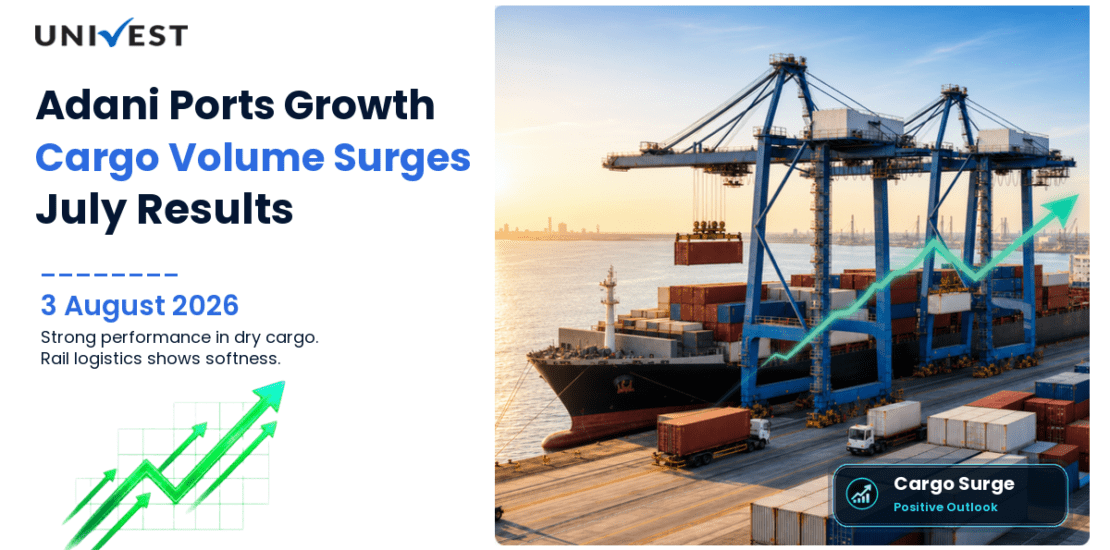
Adani Ports cargo volume 46.3 MMT in July 2026, up 15% YoY. Dry cargo up 21% YoY. YTD FY27 cargo 184.4 MMT, up 15%. Logistics rail volume 51,020 TEUs, up 5% sequentially.
Adani Ports cargo volume rose 15% year-on-year in July 2026, with the company handling 46.3 MMT of cargo during the month, led by growth across all cargo categories including dry cargo, which was up 21% YoY.
Click Here – Get Free Investment Predictions
On a year-to-date basis for FY27, Adani Ports and Special Economic Zone handled 184.4 MMT of cargo, up 15% YoY, led by containers, which grew 15%, and dry cargo, which also grew 15%. The consistency across categories suggests the Adani Ports cargo volume growth is broad-based rather than driven by one segment.
Adani Ports Cargo Volume: Segment-Wise Breakdown
The July 2026 Adani Ports cargo volume growth of 15% was led by across-the-board gains, with dry cargo the standout at 21% YoY growth. Containers and dry cargo both grew 15% on a YTD basis for FY27, pointing to steady momentum in the company’s core port operations.
| Metric | Jul 2026 | YoY Change |
|---|---|---|
| Total cargo volume | 46.3 MMT | +15% |
| Dry cargo | – | +21% |
| YTD FY27 cargo (through Jul) | 184.4 MMT | +15% |
| Logistics rail volume (Jul) | 51,020 TEUs | -16% YoY, +5% sequential |
| YTD rail volume | 1,96,330 TEUs | -18% |
Adani Ports Logistics Rail Volumes Lag Cargo Growth
While overall Adani Ports cargo volume grew strongly, the logistics rail business told a more mixed story. Rail volume for July stood at 51,020 TEUs, up 5% sequentially but down 16% YoY. On a YTD basis, rail volumes were down 18% YoY at 1,96,330 TEUs, a trend investors will want to watch alongside the strong core cargo numbers.
Track Adani Ports fundamentals on the Univest Screener
Adani Ports Stock: What This Means for Investors
Strong Adani Ports cargo volume growth is typically viewed as a positive leading indicator for revenue, given the company’s position as India’s largest private port operator. The divergence between cargo growth and rail logistics volumes is worth monitoring in the upcoming quarterly results.
Download the Univest iOS App or Univest Android App to track Adani Ports live price and get daily research insights.
Conclusion
Adani Ports cargo volume grew 15% in July 2026 to 46.3 MMT, with dry cargo leading the gains at 21% YoY growth, even as logistics rail volumes remained soft. Investors should track the next quarterly results for confirmation of the trend, and consult a SEBI-registered advisor before making investment decisions.
Disclaimer: Data and figures in this article are sourced from publicly available information. These may or may not be accurate. Please verify all data with the official NSE (nseindia.com) and BSE (bseindia.com) websites before making any investment decision. Investments in securities are subject to market risk. This content is for educational purposes only and is not investment advice by Univest (SEBI RA INH000013776).
Frequently Asked Questions
What was the Adani Ports cargo volume in July 2026?
Ans. Adani Ports cargo volume stood at 46.3 MMT in July 2026, up 15 percent year-on-year, led by growth across all cargo categories.
How much did dry cargo grow for Adani Ports in July 2026?
Ans. Dry cargo handled by Adani Ports grew 21 percent year-on-year in July 2026.
What is the YTD Adani Ports cargo volume for FY27?
Ans. On a year-to-date basis through July 2026, Adani Ports cargo volume stood at 184.4 MMT, up 15 percent year-on-year.
How did Adani Ports logistics rail volumes perform?
Ans. Adani Ports logistics rail volume was 51,020 TEUs in July 2026, up 5 percent sequentially but down 16 percent year-on-year.
Where can I track Adani Ports share price live?
Ans. You can track Adani Ports share price, fundamentals and analyst views live on the Univest Screener and the Univest app.
Should I buy Adani Ports shares after the cargo volume data?
Ans. Whether to buy Adani Ports shares depends on your risk appetite, investment horizon and portfolio context. Consult a SEBI-registered advisor before making investment decisions.
