
5 Textile Stocks in India with Strong Future Roadmaps as Export Opportunities and Domestic Fashion Growth Drive Sector Revival
- August 25, 2026
- Posted by: Lakshit Sharma
- Category: Market
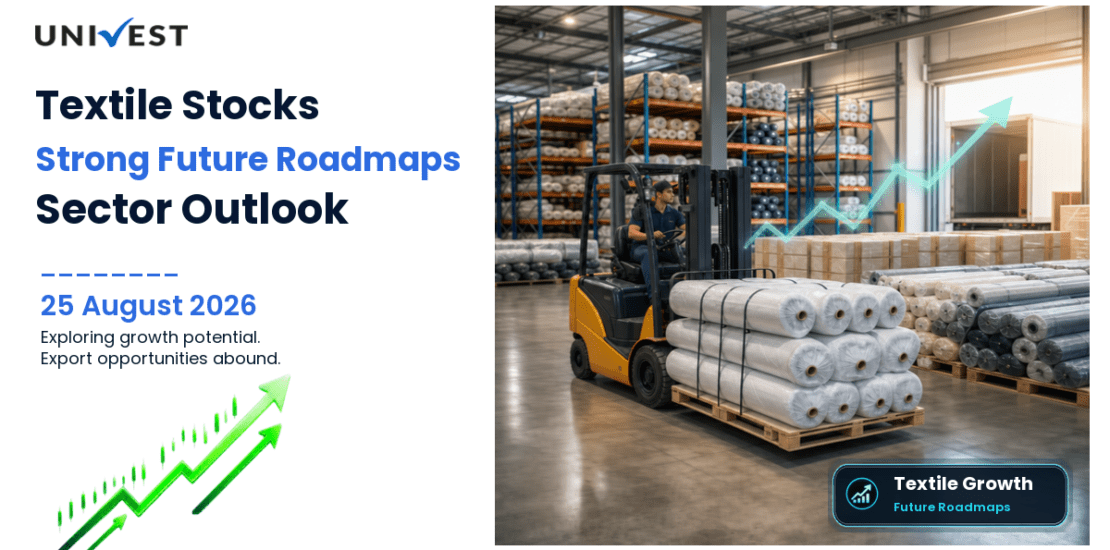
India textile exports FY26: USD 44 Bn+. Page Industries ROE 50.83% — sector-leading. Page Industries MCap Rs 39,569 Cr. Sector PE 35.18. KPR Mill MCap Rs 38,105 Cr. China plus one sourcing creating export opportunity. 5 picks: PAGEIND, KPRMILL, WELSPUNLIV, ARVIND, VTL.
Quick Answer
Five textile stocks in India with strong future roadmaps are Page Industries (Jockey India), KPR Mill, Welspun Living, Arvind Limited, and Vardhman Textiles. India’s textile sector is benefiting from the China-plus-one sourcing strategy by global brands, rising domestic apparel consumption, and expanding export opportunities in home textiles. Page Industries leads with an exceptional ROE of 50.83% — the highest of any stock covered across all sectors in this series. KPR Mill has consistently grown revenue and margin through a vertically integrated model from yarn to garments.
India’s textile sector is at an inflection point driven by two structural forces: the China-plus-one sourcing diversification by global brands looking to reduce dependency on Chinese manufacturing, and the rapid growth of India’s organised branded apparel market as urban consumers shift from local tailors to branded fashion. India’s textile exports grew 8% in FY26 despite global demand softness, reflecting market share gains from China and Bangladesh.
For investors, textile stocks offer a mix of consumer brand quality (Page Industries) and manufacturing competitiveness (KPR Mill, Welspun Living). Valuations vary widely from premium PE for Page Industries to value PE for Vardhman and Arvind. All price and fundamental data is as of 25 August 2026.
Click Here – Get Free Investment Predictions
What Are Textile Stocks in India?
Textile stocks are shares in companies that spin yarn, weave fabric, manufacture garments and home textiles, and retail branded apparel. India’s listed textile sector spans branded apparel franchisees like Page Industries, vertically integrated manufacturers like KPR Mill, home textile exporters like Welspun Living, fabric-to-brand integrated companies like Arvind, and yarn and fabric manufacturers like Vardhman Textiles. Textile stocks serve both domestic consumption (apparel, innerwear) and export markets (US and European retailers sourcing from India).
Budget 2026-27 Impact on Textile Stocks
Click Here – Get Free Investment Predictions
- PM MITRA Mega Textile Parks: Rs 4,445 crore allocation: PM MITRA (Production Linked Integrated Textile Parks) create manufacturing clusters that reduce logistics costs and enable textile stocks to compete more effectively in global sourcing.
- PLI Textiles scheme: Rs 10,683 crore for man-made fibre: Production-linked incentives for man-made fibre (MMF) textiles reduce India’s 30-year dependence on cotton and create new export competitive categories for textile stocks.
- RoDTEP scheme for export textile competitiveness: Remission of duties and taxes on exported products scheme refunds embedded duties for textile stocks exporting to US and EU, improving export price competitiveness.
- India-UAE and India-Australia FTAs: Zero-duty access for Indian garments under FTAs creates new market opportunities for textile stocks in the Gulf and Oceania.
- Anti-dumping duties on Chinese textile imports: Government protection of domestic textile manufacturers against dumped Chinese fabric creates pricing stability for domestic textile stocks.
5 Textile Stocks in India to Watch in 2026
| Company | CMP (Rs) | Market Cap (Rs Cr) | P/E Ratio | ROE (%) |
|---|---|---|---|---|
| Page Industries (Jockey India) | 35,320 | 39,569 | 52.35 | 50.83% |
| KPR Mill | 1,115 | 38,105 | 41.77 | 15.21% |
| Welspun Living | 190 | 17,988 | 62.84 | 4.16% |
| Arvind Limited | 537 | 14,454 | 33.61 | 10.24% |
| Vardhman Textiles | 607 | 17,345 | 20.17 | 7.09% |
Data as of 25 August 2026. For 52-week high/low, verify at nseindia.com before making any investment decision.
1. Page Industries (Jockey India) (NSE: PAGEIND)
Page Industries is the exclusive licensee of Jockey brand in India and the most exceptional textile stock in the country by ROE, delivering 50.83% return on equity — the highest across all sectors covered in this series. Founded in 1994 and headquartered in Bengaluru, the company manufactures and sells Jockey innerwear, leisurewear, and swimwear across India through 1,200+ exclusive brand outlets and 70,000+ multi-brand retailers. Market cap is Rs 39,569 crore at CMP Rs 35,320. PE is 52.35, ROE is 50.83%, and dividend yield is 1.55%. Page’s brand moat and Jockey’s global quality reputation make it one of the most defensible consumer franchises in India. The premiumisation of innerwear is Page’s structural growth driver. For investors in textile stocks who want the most premium brand franchise with exceptional capital efficiency, Page Industries is in a class of its own.
2. KPR Mill (NSE: KPRMILL)
KPR Mill is one of India’s most operationally efficient vertically integrated textile stocks, spanning cotton yarn, knitted fabric, garments, and retail (FASO brand). Founded in 1984 and headquartered in Coimbatore, the company exports garments to Europe, USA, and Japan while growing its domestic branded retail. Market cap is Rs 38,105 crore at CMP Rs 1,115. PE is 41.77, ROE is 15.21%, and D/E is 0.10. KPR Mill’s ethical sourcing certifications (GOTS, OEKO-TEX) have made it a preferred supplier for European sustainable fashion brands. The company has also invested in ethanol production from its sugar cane operations, diversifying its revenue base. For investors in textile stocks who want a vertically integrated export manufacturer with premium domestic retail ambition and consistent execution, KPR Mill is the most comprehensive mid-cap choice.
Check the Univest Screener for Live Fundamental Data on These Stocks
3. Welspun Living (NSE: WELSPUNLIV)
Welspun Living is India’s largest home textiles exporter and one of the world’s leading providers of towels and bed sheets to global retailers. Founded in 1985 and headquartered in Mumbai, the company supplies to Walmart, Target, IKEA, and other global retailers under private label and the Welspun brand from its Gujarat and Anjar manufacturing plants. Market cap is Rs 17,988 crore at CMP Rs 190. PE of 62.84 is elevated because the company is in a recovery and reinvestment phase; ROE of 4.16% is below peer levels reflecting this. D/E is 0.47. Welspun Living’s scale (200 million metres of terry towel capacity annually) gives it cost advantages over smaller home textile competitors. For investors in textile stocks who want exposure to the global home textiles supply chain with a recovering ROE story, Welspun Living is the most directly leveraged play on India’s home textile export opportunity.
4. Arvind Limited (NSE: ARVIND)
Arvind Limited is one of India’s most diversified textile stocks, spanning denim fabric manufacturing (India’s largest denim maker), branded retail (Arrow, Tommy Hilfiger India, Flying Machine, US Polo), and advanced materials for defence and industrial applications. Founded in 1931 and headquartered in Ahmedabad, the company manufactures 110 million metres of denim fabric annually for global brands. Market cap is Rs 14,454 crore at CMP Rs 537. PE is 33.61, below sector average, ROE is 10.24%, and D/E is 0.41. Arvind’s denim position is a global supply advantage for brands that source from India under China-plus-one mandates. The branded retail business (Arrow, Tommy Hilfiger) provides a consumer segment premium. For investors in textile stocks who want the most diversified exposure from fabric manufacturing to branded retail, Arvind Limited offers the broadest portfolio.
Download the Univest iOS App or Univest Android App to track live prices and expert research.
5. Vardhman Textiles (NSE: VTL)
Vardhman Textiles is one of India’s largest yarn manufacturers and a textile stock at the upstream end of the value chain, supplying cotton and synthetic yarn to domestic and international fabric manufacturers. Founded in 1962 and headquartered in Ludhiana, the company operates 1.2 million yarn spindles, 5,700 fabric looms, and 30 million metres of fabric production annually. Market cap is Rs 17,345 crore at CMP Rs 607. PE of 20.17 is the most attractive among these textile stocks — below the sector average — ROE is 7.09%, and D/E is 0.18. Vardhman’s scale in yarn creates cost efficiencies, and its Ludhiana location gives it access to India’s largest hosiery and knitwear manufacturing cluster. For value-oriented investors in textile stocks who want the most cheaply valued large-scale upstream manufacturer with a low PE, Vardhman Textiles is the clear value entry point.
What Factors Affect Textile Stocks?
- China-plus-one sourcing decisions by global brands: Global apparel brands including Walmart, H&M, and Inditex are diversifying their supply chains away from China. Indian textile stocks with certified ethical manufacturing and quality capability are the primary beneficiaries.
- Cotton price cycles: Cotton is the primary raw material for most textile stocks. Cotton price spikes reduce garment and fabric margins; price normalisation expands them.
- Currency movements (USD-INR): Export-oriented textile stocks earn in USD. A weaker INR improves export realisation in rupee terms; a stronger INR compresses it.
- Domestic branded apparel market growth: India’s branded apparel market is growing at 10-12% annually as urban consumers shift to organised retail fashion. Textile stocks with domestic brand portfolios benefit directly.
- PLI incentive eligibility and utilisation: Textile stocks that qualify for PLI on man-made fibre and technical textiles products receive production-linked subsidies that directly improve margins in eligible product categories.
Benefits of Investing in Textile Stocks
- China-plus-one creating decade-long sourcing opportunity: Global brands systematically shifting supply chain to India are creating multi-year order growth for Indian textile stocks with certified export manufacturing capabilities.
- Premiumisation of innerwear and casual wear: Page Industries’ success proves the premiumisation of innerwear in India. The same dynamic is playing out across sportswear, casual wear, and sustainable fashion.
- Vertically integrated cost advantages: KPR Mill and Welspun Living demonstrate that vertical integration from raw material to finished product creates structural cost and quality control advantages over non-integrated competitors.
- PLI and PM MITRA creating manufacturing competitive edge: Government infrastructure investment in textile parks and PLI incentives are reducing the total cost disadvantage of Indian manufacturing versus Bangladesh and Cambodia.
- Ethanol diversification for cotton mill sugar operations: Companies like KPR Mill that have adjacent sugar and ethanol operations create revenue diversification that pure textile stocks lack.
Risks to Consider Before Investing
- Bangladesh and Vietnam competition in garment exports: Bangladesh and Vietnam have lower labour costs than India for basic garment manufacturing. Indian textile stocks must target higher-value, quality-certified, or sustainable sourcing categories.
- Cotton price and availability volatility: India’s cotton production is monsoon-dependent. A weak cotton crop raises raw material costs for all cotton-based textile stocks simultaneously.
- Global demand slowdown affecting export orders: When US and European consumer spending weakens, global apparel brand orders reduce and Indian textile stocks see order book shrinkage.
- Currency risk on USD-denominated export revenue: Export-oriented textile stocks are exposed to INR appreciation against the USD. Hedging costs reduce realisation, and unhedged positions face spot market risk.
- Working capital intensity: Textile manufacturing requires significant yarn, fabric, and finished goods inventory. Textile stocks with poor working capital management face cash flow pressure, particularly during cotton price spikes.
How to Choose Textile Stocks
- ROE above 15% as capital efficiency benchmark: Page Industries (50.83%), KPR Mill (15.21%) demonstrate what strong textile stocks deliver. Vardhman (7.09%) and Welspun (4.16%) are in recovery phases.
- Export versus domestic revenue mix: Textile stocks with 50%+ export revenue benefit from China-plus-one opportunity but face currency and global demand risk. Domestic-focused stocks like Page Industries have more stable revenue.
- Value chain position: Branded consumer-facing textile stocks (Page) generate the highest margins. Downstream fabric and yarn manufacturers (Vardhman) generate the lowest. Vertically integrated companies (KPR, Welspun) are in between.
- PE near sector average of 35: Textile stocks trading at or below sector PE of 35.18 (Vardhman at 20, Arvind at 33) offer value entry. Page Industries at PE 52 commands a brand premium.
- Ethical certification for export competitiveness: Textile stocks with GOTS, OEKO-TEX, and sustainable sourcing certifications are better positioned for European and US brand mandates as sustainability requirements tighten.
How to Invest in Textile Stocks in India
Step 1: Open a SEBI-registered demat account. Univest offers zero-brokerage broking with integrated research, so you can screen, research, and invest in textile stocks from one platform.
Step 2: Use the Univest Screener to filter the sector by PE, ROE, D/E, and revenue growth. This gives you a ranked snapshot of all listed textile companies.
Step 3: Review financial statements of your shortlist. Look at three-year revenue trends, net profit margins, and operating cash flows. Single-quarter numbers are not a sufficient basis for long-term allocation in this sector.
Step 4: Decide on position size based on your risk tolerance. High-growth textile stocks carry more volatility than diversified blue-chips. Diversify across two or three names rather than concentrating in one.
Step 5: Set price alerts and monitor quarterly results. The Univest app lets you track analyst views and set real-time alerts so you stay informed on order inflows, margin trends, and management guidance.
Conclusion
The five textile stocks covered here, Page Industries, KPR Mill, Welspun Living, Arvind, and Vardhman Textiles, span India’s textile sector from premium branded innerwear to export-focused home textiles and upstream yarn manufacturing. China-plus-one sourcing, branded apparel growth, and PLI incentives create multi-year tailwinds. Cotton price volatility and Bangladesh competition are the key risks. Consult a SEBI-registered investment advisor before making any investment decisions.
Disclaimer: Data and figures in this article are sourced from publicly available information. These may or may not be accurate. Please verify all data with the official NSE (nseindia.com) and BSE (bseindia.com) websites before making any investment decision. Investments in securities are subject to market risk. This content is for educational purposes only and is not investment advice by Univest (SEBI RA INH000013776).
FAQs on Textile Stocks in India 2026
Which are the top 5 textile stocks in India in 2026?
Ans. The top 5 textile stocks in India as of August 2026 are Page Industries/Jockey India (PAGEIND), KPR Mill (KPRMILL), Welspun Living (WELSPUNLIV), Arvind Limited (ARVIND), and Vardhman Textiles (VTL). Page Industries has the highest ROE at 50.83% — the highest of any stock covered across all sectors in this series. Vardhman Textiles offers the most attractive PE at 20.17.
Why is Page Industries’ ROE so exceptional among textile stocks?
Ans. Page Industries’ 50.83% ROE is driven by its asset-light Jockey brand licensee model — the company manufactures using efficient owned plants but does not invest in brand development (Jockey brand is owned by HBI USA). The brand loyalty from Jockey’s global quality reputation means Page India pays minimal marketing costs relative to revenue. High pricing power from brand premium combined with low capital intensity creates India’s highest ROE in the textile sector.
What is the China-plus-one opportunity for textile stocks?
Ans. Global apparel brands including Walmart, H&M, Zara, and Gap that concentrated sourcing in China are systematically qualifying Indian suppliers to reduce concentration risk. India’s textiles exports grew while China’s share of global apparel exports declined from 45% to 30% over the past decade. Indian textile stocks with certified quality factories, ethical sourcing compliance, and competitive pricing are benefiting from 10-15% annual export growth.
What is KPR Mill’s competitive advantage as a textile stock?
Ans. KPR Mill’s vertical integration from cotton yarn to knitted garments to retail (FASO brand) gives it cost advantages at each step of the value chain. Its GOTS and OEKO-TEX certifications make it a preferred supplier for European sustainable fashion brands, which pay premium prices for certified ethical sourcing. ROE of 15.21% confirms value creation above cost of capital, and the near-zero debt (D/E 0.10) provides expansion flexibility.
Is Welspun Living a recovery play among textile stocks?
Ans. Welspun Living’s ROE of 4.16% is below the quality threshold but reflects a deliberate reinvestment phase — the company is expanding capacity for bed sheets and rugs while upgrading its branded Welspun retail footprint. Given its scale (world’s largest terry towel exporter) and established retail relationships with Walmart and IKEA, the recovery thesis is credible but execution-dependent. Investors in textile stocks willing to wait for ROE recovery would find Welspun’s value case interesting.
Why is Vardhman Textiles the cheapest PE among textile stocks?
Ans. Vardhman Textiles trades at PE 20.17, below the sector average of 35.18, because it operates at the yarn and fabric stage of the value chain where margins are lower and more commodity-driven than branded consumer textile stocks. ROE of 7.09% is below the sector average. The market prices upstream manufacturers at lower PEs than vertically integrated or branded peers. For investors who want yarn manufacturing scale at value pricing, Vardhman’s PE-to-quality trade-off is clear.
How do I invest in textile stocks in India?
Ans. To invest in textile stocks, open a demat account with a SEBI-registered broker, filter by ROE, export revenue share, ethical certification status, PE relative to sector average, and value chain position. Review quarterly same-store sales growth for branded textile stocks and export order book data for manufacturing-focused textile stocks. Consult a SEBI-registered investment advisor before investing.