
3 Marine Port and Services Stocks with Strong Growth Plans in India (2026)
- August 20, 2026
- Posted by: Kunal Singla
- Category: Market
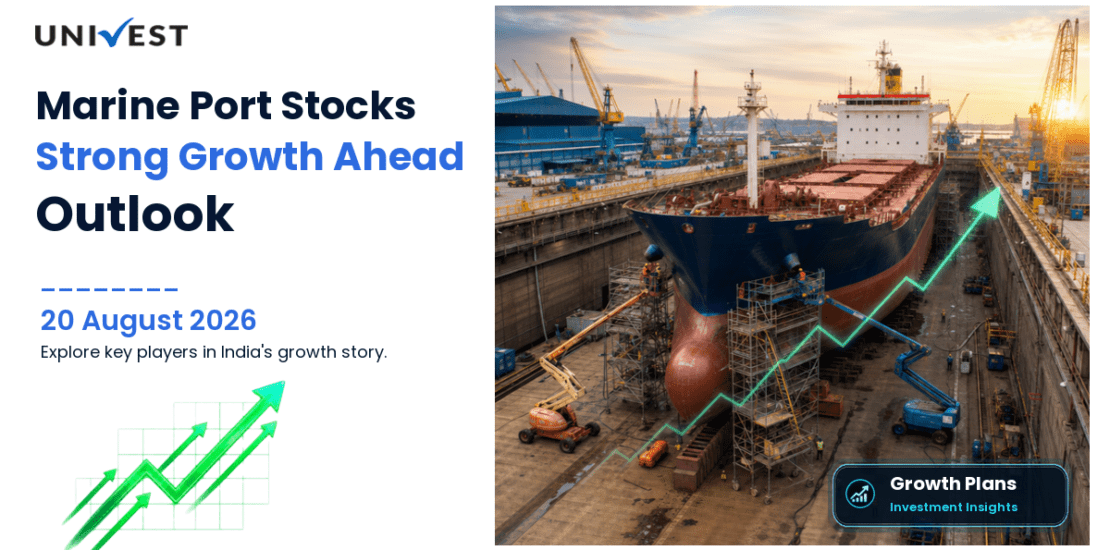
Adani Ports MCap Rs 3,87,180 Cr, India largest port operator. JSW Infrastructure MCap Rs 76,715 Cr. Gujarat Pipavav MCap Rs 7,754 Cr dividend yield 6.48%. India targets 10,000 MMTPA port capacity by 2030.
Quick Answer
Adani Ports and Special Economic Zone, JSW Infrastructure, and Gujarat Pipavav Port are three marine port stocks with strong growth plans backed by India’s booming trade volumes and the government’s Sagarmala port-led development programme. India’s port handling capacity crossed 2,500 MMTPA in FY26, and the government targets 10,000 MMTPA capacity by 2030. All three marine port stocks are adding berths, deepening channels, or acquiring new concessions to capture this growing cargo pipeline. Marine port stocks are among the most asset-heavy, long-duration businesses in Indian equity markets, with concession periods of 30-50 years providing exceptional revenue visibility once operations begin.
Marine port stocks in India represent one of the most strategically important infrastructure asset classes in the equity market. Ports are the gateway for India’s $1 trillion+ merchandise trade, and their efficiency determines the competitiveness of the entire export-import economy. Adani Ports and Special Economic Zone, JSW Infrastructure, and Gujarat Pipavav Port occupy different positions in India’s port ecosystem: Adani is the diversified national champion, JSW Infrastructure is the industrials-linked mid-cap challenger, and Gujarat Pipavav is the focused container and bulk cargo port with exceptional income characteristics.
India’s Sagarmala programme, which has allocated Rs 6 lakh crore for port-led development, is creating new greenfield port capacity and upgrading existing infrastructure. This policy push, combined with rising trade volumes from India’s expanding manufacturing base (driven by PLI schemes and China+1 supply chain shifts), creates a sustained demand environment for marine port stocks. The infrastructure multiplier effect of ports, which every Rs 1 of port investment generates Rs 3-4 of downstream economic activity, makes them a strategic priority for the government and a compelling investment thesis for patient capital.
Click Here – Get Free Investment Predictions
What Are Marine Port Stocks?
Marine port stocks are shares of companies that develop, operate, or provide services related to seaports, jetties, and maritime infrastructure. In India, marine port stocks include major port operators (Adani Ports, JSW Infrastructure, Essar Ports), container terminal operators (Gujarat Pipavav, Mundra Port), liquid cargo terminal operators (BPCL terminals), and port-adjacent industrial parks and special economic zones (Adani APSEZ).
Revenue for marine port stocks comes from cargo handling charges (per tonne or per TEU for container traffic), berth hire charges, vessel-related services, storage and warehousing, and port-adjacent industrial park leases. Key metrics include total cargo handled (MMTPA), capacity utilisation rate, and revenue per tonne, which together drive EBITDA and return on capital employed.
Why Do These Three Marine Port Stocks Have Strong Growth Plans?
India’s merchandise exports crossed $450 billion in FY26 and are targeted to reach $1 trillion by FY30. Every additional dollar of merchandise trade requires port capacity to handle it. The three marine port stocks covered here are in ideal positions to capture this export growth: Adani Ports through its dominant national network, JSW Infrastructure through its integration with JSW Group’s steel and energy volumes, and Gujarat Pipavav through its deep water advantage and superior connectivity to Gujarat’s vast manufacturing base.
Container traffic is the fastest-growing cargo category, driven by e-commerce exports, textiles, pharmaceuticals, and electronics. All three marine port stocks are investing in or already operating container terminals designed for ultra-large container ships (20,000+ TEU capacity), which are becoming the dominant vessel class for Indian trade as global shipping scales up.
3 Marine Port Stocks with Strong Growth Plans
| Company | CMP (Rs) | Market Cap (Rs Cr) | PE Ratio | ROE (%) |
|---|---|---|---|---|
| Adani Ports and Special Economic Zone Ltd. (ADANIPORTS) | 1,681.90 | 3,87,180 | 29.51 | 13.32% |
| Gujarat Pipavav Port Ltd. (GPPL) | 165.13 | 7,754 | 13.88 | 21.57% |
| JSW Infrastructure Ltd. (JSWINFRA) | 329.90 | 76,715 | 50.65 | 14.00% |
Data as of 19 August 2026, NSE. Prices are indicative and change in real time.
1. Adani Ports and Special Economic Zone Limited (ADANIPORTS)
Founded in 1998 and headquartered in Ahmedabad, Adani Ports and Special Economic Zone (APSEZ) is India’s largest private port operator, handling approximately 40% of India’s container traffic through its 17 ports and terminals across 9 coastal states. Mundra Port in Gujarat is the largest commercial port in India by cargo tonnage, handling over 170 MMTPA. Among marine port stocks, Adani Ports is the clear national champion with unmatched geographic diversification and cargo mix across containers, bulk, and liquid cargoes.
APSEZ’s growth plan targets cargo handling of 500 MMTPA by FY30 (from approximately 400 MMTPA in FY26) through capacity additions at existing ports and potential new acquisitions. The company is also growing its logistics business (Adani Logistics), connecting its ports to inland customers via rail and road, which creates an integrated logistics revenue stream beyond pure port handling. APSEZ’s EBITDA margins consistently exceed 65%, among the highest for any port operator globally. At PE 29.51 (below the industry average of 30.90) and ROE 13.32%, APSEZ is one of the more attractively valued of the large-cap marine port stocks. D/E of 0.66 reflects the capital-intensive port development model and is standard for the sector.
2. Gujarat Pipavav Port Limited (GPPL)
Founded in 1992 and headquartered in Mumbai, Gujarat Pipavav Port is a deep-water container and bulk cargo port on the Gulf of Khambhat, Gujarat, majority-owned by AP Moller Terminal (the Maersk Group). The port has a designed capacity of approximately 2 MMTPA of containers and 5 MMTPA of bulk cargo, with direct rail connectivity to Delhi via the Western Dedicated Freight Corridor. Among marine port stocks, Gujarat Pipavav stands out for its exceptional financial characteristics: PE of 13.88 (the lowest among these three marine port stocks), ROE of 21.57% (the highest), and a dividend yield of 6.48% that makes it one of the highest-yielding infrastructure stocks in India.
Gujarat Pipavav’s growth plan targets a 30% increase in container throughput by FY28 through a berth deepening project that will allow handling of larger post-Panamax vessels, and new customer acquisition from Rajasthan and Madhya Pradesh hinterland that is growing rapidly due to textile and pharmaceutical exports. D/E of 0.02 is negligible, reflecting the port’s fully operational, debt-free status. The Maersk parentage ensures world-class operational standards and a direct pipeline of global shipping business that independent marine port stocks cannot match. For income-seeking investors, Gujarat Pipavav offers one of the most compelling combinations of high yield, low valuation, and infrastructure quality among listed marine port stocks.
Explore the Univest Screener to Compare These Stocks Live
3. JSW Infrastructure Limited (JSWINFRA)
Founded in 2006 and listed in 2023 as a part of the JSW Group demerger, JSW Infrastructure is India’s second-largest commercial port operator by capacity, with 10 ports across 5 states handling over 170 MMTPA of cargo. The company’s ports are strategically located near JSW Group’s steel plants and power assets, which provide a large captive cargo base of coal, iron ore, steel products, and bulk materials. Among marine port stocks, JSW Infrastructure has the unique advantage of integrated group cargo that provides revenue floor regardless of external market conditions.
JSW Infrastructure’s growth plan targets 300 MMTPA capacity by FY30 (from ~170 MMTPA currently) through greenfield port development and potential acquisitions of third-party terminals. The company’s third-party cargo share (non-JSW Group cargo) is growing as a percentage of total throughput, which improves revenue diversification and reduces dependency on group captive business. PE of 50.65 (above the industry average of 30.90) reflects the market’s premium for JSW Infrastructure’s post-IPO growth story and the group integration value. ROE of 14.00% is healthy for a recently listed infrastructure company in capital deployment mode. D/E of 0.63 is typical for a port-development business with capital needs.
Download the Univest iOS App or Univest Android App to track live prices and get daily research on marine port stocks.
What Are the Key Growth Drivers for Marine Port Stocks in India?
India’s merchandise trade targeting $1 trillion by FY30: Every dollar of merchandise trade requires port infrastructure to handle it. The government’s export target creates a direct demand pull for marine port stocks to expand handling capacity at both container and bulk cargo terminals.
Sagarmala programme allocating Rs 6 lakh crore for port development: The government’s port-led development programme is funding new greenfield ports, berth deepening, rail and road connectivity improvements, and port-adjacent industrial parks. This investment directly improves the commercial viability of marine port stocks by enhancing their catchment areas and reducing hinterland logistics costs.
China+1 manufacturing shift increasing containerised export volumes: Global companies diversifying manufacturing from China to India are generating new containerised exports (electronics, textiles, pharmaceuticals). This China+1 trend benefits container-focused marine port stocks like Gujarat Pipavav and APSEZ’s Mundra terminal disproportionately.
Dedicated Freight Corridors connecting ports to inland markets: The Western Dedicated Freight Corridor connects JNPT and Mundra to North India’s manufacturing belt at significantly lower cost and transit time than road. This connectivity improvement makes marine port stocks anchored to DFC access significantly more attractive for cargo owners, potentially diverting traffic from less well-connected competitors.
LNG and energy trade growing coastal infrastructure needs: India’s LNG imports and coastal power plant coal deliveries are growing rapidly, creating demand for dedicated liquid and bulk port terminals. Marine port stocks with energy cargo terminals (like Adani Ports at Dhamra and APSEZ LNG) benefit from this energy import growth alongside containerised trade.
What Risks Should Investors Consider Before Buying Marine Port Stocks?
Global trade cycle sensitivity: Marine port stocks are exposed to the global merchandise trade cycle. A slowdown in India’s exports or imports due to global recession, trade tariff escalations, or major geopolitical events would reduce throughput and revenue growth for port operators.
Large capital requirements for greenfield development: New port berths and deepening projects cost hundreds to thousands of crore. Marine port stocks undertaking aggressive greenfield development carry elevated debt and construction risk, and any project delay can affect revenue timelines and investor returns.
Competition from government-owned major ports: The 12 Major Ports of India operated by the government compete directly with private marine port stocks. Government ports may offer lower tariffs or operational advantages due to their legacy infrastructure, putting pricing pressure on private operators in certain cargo categories.
Currency and commodity cycle risk for cargo volumes: Bulk cargo volumes (coal, iron ore) are tied to domestic industrial activity and commodity prices. A slump in steel production (reducing iron ore demand) or a shift toward renewable energy (reducing thermal coal imports) could affect cargo volumes at bulk-focused marine port stocks like Gujarat Pipavav and JSW Infrastructure.
How to Choose the Right Marine Port Stock?
Assess cargo mix: containers grow faster than bulk: Container cargo is growing at 10-12% annually versus 3-5% for bulk cargo. Marine port stocks with higher container revenue mix (like Gujarat Pipavav) will grow faster than bulk-heavy peers, everything else being equal.
Check the hinterland connectivity advantage: The most valuable marine port stocks have direct rail access to industrial heartlands. APSEZ’s Mundra port and JSW Infrastructure’s major ports have rail connectivity that improves their long-term cargo capture potential over road-dependent competitors.
Consider valuation relative to asset quality: Gujarat Pipavav at PE 13.88 and ROE 21.57% offers the best combination of value and returns among these three marine port stocks. APSEZ at PE 29.51 offers scale diversification. JSW Infrastructure at PE 50.65 is the premium-growth option among these marine port stocks.
Evaluate dividend yield as a sign of financial maturity: Gujarat Pipavav’s 6.48% dividend yield signals that the port is operationally mature and generating excess cash. Marine port stocks paying high dividends have typically passed the high-capex development phase and are generating strong free cash flows.
How to Invest in Marine Port Stocks in India?
Step 1: Track monthly cargo throughput data from the Ministry of Ports. Monthly cargo data is published by the Ministry of Ports, Shipping and Waterways on its website. Rising cargo traffic at specific ports is the leading indicator of near-term revenue improvement for marine port stocks.
Step 2: Monitor EXIM (export-import) policy and shipping tariff trends. Marine port stocks are affected by changes in India’s import tariffs (higher tariffs reduce imports), shipping freight rates (which influence which port is selected based on vessel routing), and government port tariff regulations that cap what private ports can charge.
Step 3: Track the DFC construction and commissioning schedule. Rail connectivity additions directly improve the cargo hinterland for connected marine port stocks. Track quarterly DFC milestone announcements and their commercial commencement dates, as these are significant positive catalysts for APSEZ and JSW Infrastructure’s rail-connected terminals.
Step 4: Plan for a 10+ year investment horizon for infrastructure marine port stocks. Port concessions run for 30-50 years, and their value compounds over decades. The appropriate holding period for marine port stocks is aligned with the duration of the underlying concession rather than quarterly earnings cycles.
Conclusion
Adani Ports, JSW Infrastructure, and Gujarat Pipavav are three marine port stocks with strong growth plans anchored in India’s expanding trade and the government’s Sagarmala port development programme. APSEZ offers national scale and cargo diversification; JSW Infrastructure offers captive industrial cargo integration with growth potential; Gujarat Pipavav offers the best value metrics with exceptional dividend yield. Marine port stocks are long-duration infrastructure assets best suited for patient investors with a horizon of 5-10+ years. Consult a SEBI-registered investment advisor before investing in any marine port stock or infrastructure asset.
Disclaimer: Data and figures in this article are sourced from publicly available information. These may or may not be accurate. Please verify all data with the official NSE (nseindia.com) and BSE (bseindia.com) websites before making any investment decision. Investments in securities are subject to market risk. This content is for educational purposes only and is not investment advice by Univest (SEBI RA INH000013776).
Frequently Asked Questions
Which marine port stocks are best to invest in India?
Ans. Adani Ports is the largest and most diversified marine port stock with a dominant national position. Gujarat Pipavav offers the best value at PE 13.88 with a 6.48% dividend yield. JSW Infrastructure is the growth option with a large capacity expansion plan. For most investors, APSEZ is the safest starting point given its scale and diversification. Please consult a SEBI-registered advisor before investing.
What is cargo throughput and why does it matter for port stocks?
Ans. Cargo throughput is the total volume of goods handled by a port in a given period, measured in million metric tonnes per annum (MMTPA) for bulk cargo or twenty-foot equivalent units (TEUs) for containers. For marine port stocks, throughput growth is the primary driver of revenue since revenue is earned on a per-tonne or per-TEU basis. Rising throughput with stable rates drives operating leverage and margin expansion.
Why does Gujarat Pipavav have such a high dividend yield?
Ans. Gujarat Pipavav’s dividend yield of 6.48% reflects its financially mature status: the port is fully built, debt-free, and generating consistent free cash flow that management has chosen to distribute to shareholders rather than retain for new construction. This makes it different from marine port stocks like JSW Infrastructure that are in active capital deployment phases. High-yield marine port stocks like Gujarat Pipavav suit income investors; lower-yield growth-oriented marine port stocks suit capital appreciation investors.
What is the Sagarmala Programme?
Ans. Sagarmala is the Government of India’s port-led national development programme, which has identified Rs 6 lakh crore in investments across port modernisation, port connectivity enhancement, port-led industrialisation, and coastal community development. The programme is expected to reduce logistics costs by 25% and unlock 10 lakh crore in incremental exports by 2025-30. Marine port stocks operating in Sagarmala-designated port zones benefit from improved connectivity infrastructure funded by the government.
How does APSEZ’s SEZ business complement its port operations?
Ans. Adani Ports’ Special Economic Zone at Mundra is one of India’s largest private SEZs, providing warehousing, manufacturing, and logistics services to companies within the export-import zone. The SEZ provides a captive cargo source for the adjacent Mundra Port and generates commercial real estate and service revenue beyond pure port handling. This land-monetisation component adds a diversification layer that most other marine port stocks do not have.
What is the risk of Adani Group governance for APSEZ investors?
Ans. As a part of the broader Adani Group, APSEZ carries group-level governance scrutiny that is a legitimate investor concern. Investors in Adani Ports should assess the company independently on its port fundamentals (which are strong and globally competitive), while factoring in a governance risk premium relative to similarly positioned marine port stocks without group-level concerns. The port assets themselves are strategically located and generate strong cash flows regardless of holding company dynamics.
