
Wall Street Rout After the US Midterms: How the AI Selloff Is Spreading Beyond Big Tech to Riskier Stocks as Hedge Fund Selling and Volatility Build
- November 6, 2026
- Posted by: Chaitanya Auti
- Category: News
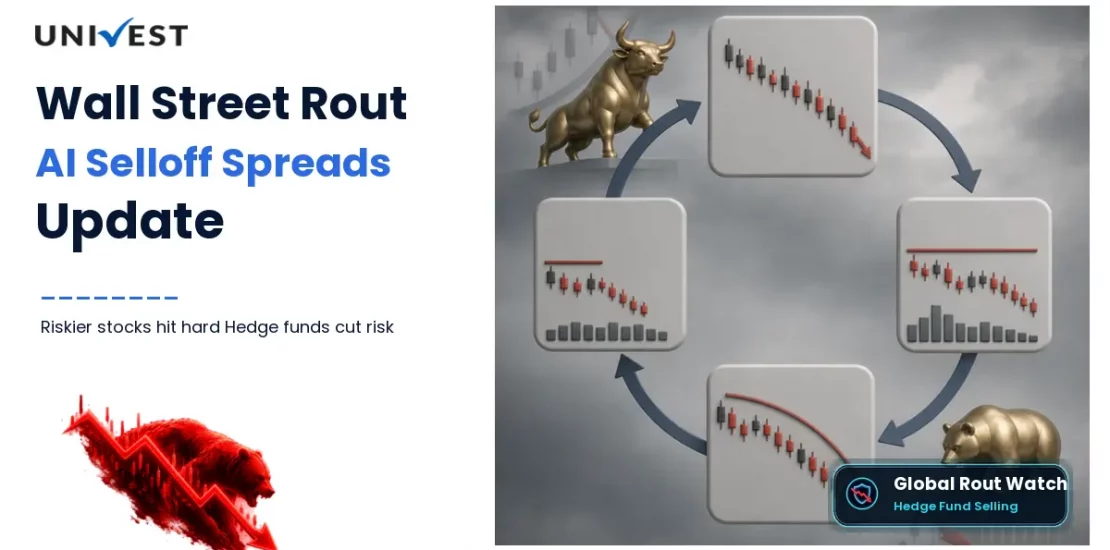
S&P 500 -4.36%, Nasdaq Composite -5.52%, Russell 2000 -4.44%. VIX close 27.13 (high 28.09). Leveraged ETFs: about USD 47 bn sales. Press reports, 5 Nov 2026.
Quick Answer
Wall Street rout on 5 November 2026: the S&P 500 fell 4.36% and the Russell 2000 fell 4.44% as hedge fund selling and a jump in volatility spread the AI selloff beyond Big Tech. The VIX closed near 27, and Indian markets face a weak start.
Wall Street rout on Thursday, 5 November 2026: the S&P 500 fell 4.36% and the small-cap Russell 2000 fell 4.44% as hedge fund selling and a jump in volatility spread the AI selloff beyond Big Tech, per Reuters-based reports. The VIX fear gauge closed near 27. Figures below come from Reuters and other press reports and may differ by source. Mint’s headline also mentions unprofitable tech firms, heavily shorted stocks and companies with fragile balance sheets, but I found no figures for those groups, so they are described only in general terms. This is not investment advice.
Click Here – Get Free Investment Predictions
Wall Street Rout: The Numbers
| Gauge | 5 November 2026 |
|---|---|
| S&P 500 | Down 4.36% to 7,353.73 |
| Nasdaq Composite | Down 5.52% to 24,315.00 |
| Dow Jones Industrial Average | Down 3.44% to 51,523.06 |
| Russell 2000 (small caps) | Down 4.44% to 2,729.94 |
| VIX fear gauge | Closed near 27.13; intraday high 28.09, an eight-month high |
| US 10-year Treasury yield | About 4.84% |
| Bitcoin | Down about 5.4% |
| Leveraged ETF selling (Nomura estimate) | About USD 47 billion into the close |
The Russell 2000 fell by almost the same percentage as the S&P 500, which shows the selling was not limited to a few large technology names. At its session high the VIX logged its largest one-day rise since the days after the April 2025 tariff announcement, per Reuters via Yahoo Finance. AP reported that the Nasdaq closed 11.9% below its record high.
How the AI Selloff Spread Beyond Big Tech
| Pressure point | What the press reported |
|---|---|
| Crowded AI trade | Analysts told Reuters much of the fall unwound the previous day’s rally and a crowded AI trade |
| Hedge fund selling | UBS data showed institutional selling led by hedge funds, and Goldman traders saw funds selling large tech stocks they bought the day before |
| Leveraged ETFs | Nomura expected about USD 47 billion of stock sales as leveraged funds rebalanced, the second-largest on its record since 2006 |
| Retail selling | Vanda Research expected record net selling by retail investors in single stocks since the pandemic began |
| Volatility | Rising volatility forced investors to buy protection and cut risk |
Steve Sosnick of Interactive Brokers told Reuters that the previous day’s market had assumed nobody needed protection, and that this changed on Thursday. He added that if the rethink of AI investment is lasting and not a trading rebalance, that would be a problem. That is the key uncertainty.
Track US-linked and technology stocks on the Univest Screener
Why Riskier Stocks Get Hit First
| Type of stock | Why it is exposed |
|---|---|
| Unprofitable tech firms | They depend on future earnings and on cheap funding, so higher volatility and rates hurt their valuations |
| Heavily shorted stocks | Short sellers cover when prices jump, and funds betting against stocks also face losses when these names move against them |
| Fragile balance sheets | Companies with heavy debt are vulnerable when financing conditions tighten |
| Leveraged and crowded names | Forced selling and rebalancing amplify falls |
This is general market mechanics, not a claim about specific companies. A Goldman Sachs Prime Brokerage report sent to clients on 5 November said large multi-strategy hedge funds were down significantly because of outsized exposure to big AI stocks, per Reuters. Earlier, Goldman data showed all three major hedge fund strategies it tracks lost more than 1% on 22 October, the first time since the COVID crash, and that October was the first month since 2016 in which fundamental long-short and systematic funds both fell more than 3%.
What It Means for Indian Investors
| Channel | Likely effect |
|---|---|
| Opening | Gift Nifty was about 0.65% lower in early trade on 6 November |
| Direct exposure | India has limited exposure to US AI hardware stocks |
| IT stocks | Nifty IT rose 2.4% on 5 November, and Reuters noted it often moves opposite to chip stocks |
| Small caps | Nifty Smallcap rose 0.6% on 5 November, so they were not hit before this US fall |
| Flows | Foreign investors bought about Rs 14,975 crore of Indian shares on 5 November |
The Nifty 50 closed at 24,536.60 and the Sensex at 79,310.01 on 5 November, both up about 2.4%, before the US fall. Whether Indian stocks hold depends on whether the US rout extends and whether foreign investors stay buyers. Related reads cover the AI bubble debate, the chip stocks selloff and the Kospi crash.
Download the Univest iOS App or Univest Android App to get global market alerts on your phone.
What to Watch Next
| Watch item | Reason |
|---|---|
| VIX level | A sustained high would show stress is lasting |
| Hedge fund flow data | Goldman and UBS data show whether selling continues |
| Small-cap and credit stress | These show whether the problem is spreading |
| AI spending news | It decides whether this is a rebalance or a trend change |
| Foreign flows into India | They can turn quickly in risk-off markets |
Conclusion
The Wall Street rout showed how hedge fund selling, leveraged ETFs and rising volatility can spread an AI selloff to riskier stocks. For Indian investors the effect is mostly indirect, so watch volatility and flows and size your positions to your risk.
Disclaimer: Data and figures in this article are sourced from publicly available information. These may or may not be accurate. Please verify all data with the official NSE (nseindia.com) and BSE (bseindia.com) websites before making any investment decision. Investments in securities are subject to market risk. This content is for educational purposes only and is not investment advice by Univest (SEBI RA INH000013776).
Frequently Asked Questions on the Wall Street Rout
What happened in the Wall Street rout on 5 November 2026?
Ans. The S&P 500 fell 4.36%, the Nasdaq Composite 5.52%, the Dow 3.44% and the Russell 2000 4.44%. The VIX closed near 27. Press reports link the fall to the AI trade unwinding, worries about AI infrastructure after the US midterm results and heavy hedge fund and leveraged ETF selling.
Why is the AI selloff spreading beyond Big Tech?
Ans. Forced selling, rebalancing by leveraged funds and higher volatility hit weaker stocks harder. The Russell 2000 fell 4.44%, which shows small caps were hit too. The Mint headline names unprofitable tech, heavily shorted and fragile-balance-sheet stocks, but I found no figures.
What is hedge fund selling and why does it matter?
Ans. It is selling by hedge funds to cut risk or leverage. UBS data showed selling led by hedge funds, and Goldman said big multi-strategy funds were down significantly. Such selling can push prices lower and force others to sell.
What does the VIX at 27 mean?
Ans. The VIX measures expected US stock volatility. It closed near 27.13 on 5 November and hit 28.09 intraday, an eight-month high. A higher reading means investors pay more for protection.
How are leveraged ETFs involved?
Ans. Nomura estimated leveraged ETFs would sell about USD 47 billion of stocks into the close to rebalance, the second-largest on its record since 2006. Such rebalancing can magnify late-day falls.
Will the US rout hit Indian stocks?
Ans. It can weigh on the opening, and Gift Nifty was about 0.65% lower in early trade. India has limited direct exposure to US AI hardware, and IT stocks rose 2.4% on 5 November. Foreign flows will matter.
Is this the start of a bigger correction?
Ans. No one can say. The Nasdaq closed 11.9% below its record per AP, which is a correction by the usual 10% rule, but one day does not set a trend. Earnings, AI spending news and volatility will show the direction.
Should I sell my stocks after the rout?
Ans. Univest cannot give personal advice. Selling after a sharp fall can lock in losses, while holding carries risk. Review your allocation, time horizon and risk tolerance, and consult a SEBI-registered adviser.