
Samvat 2083 Outlook: Can Investors Expect a Bull Run After the Worst Samvat in 15 Years? Sensex and Nifty Targets, Sectors and Risks
- November 5, 2026
- Posted by: Chaitanya Auti
- Category: Market
Sensex -8.4%, Nifty -7.3% in Samvat 2082 (BS, 4 Nov). Today Sensex 79,037.63 (+2.25%), Nifty 24,455.05 (+2.06%). About 1:02 PM IST, 5 Nov 2026.
Quick Answer
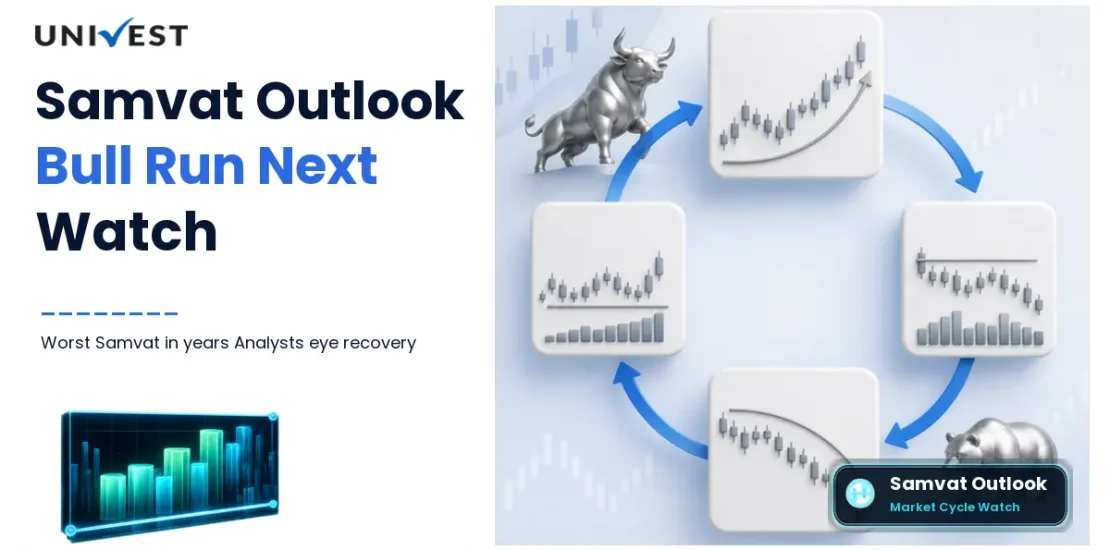
The Samvat 2083 outlook begins after the worst Samvat in 15 years, with the Sensex and Nifty down nearly 8% in Samvat 2082. Analysts expect a selective recovery, not a broad-based bull run.
The Samvat 2083 outlook begins after the worst Samvat in 15 years, with the Sensex and Nifty down nearly 8% in Samvat 2082. Analysts expect a selective recovery, not a broad-based bull run, and several see new highs by the next Diwali if earnings improve and crude and bond yields cool. Samvat 2083 starts on 8 November 2026. This guide explains what went wrong, what analysts now expect and the risks. It is not investment advice.
Click Here – Get Free Investment Predictions
How Bad Was Samvat 2082 for Sensex and Nifty?
Business Standard reported that, as of 4 November with two sessions to go, the Sensex was down 8.4% at 77,301 and the Nifty 50 down 7.3% at 23,961, against the Muhurat session levels of Samvat 2082’s start. Other reports using exchange data as of the same date put the falls at 7.9% and 6.8%, so the exact figure depends on the base date. It is the weakest Samvat showing in 15 years.
| Index | Samvat 2082 move | Note |
|---|---|---|
| Sensex | -8.4% | Business Standard, as of 4 November |
| Nifty 50 | -7.3% | Business Standard, as of 4 November |
| Nifty Smallcap 100 | +4.5% | Outperformed |
| Nifty Midcap 100 | +0.3% | Outperformed |
| Nifty FMCG | -18.3% | Worst sector |
| Nifty IT | -9.2% | Weak on US demand worries |
| Nifty Realty | -7.8% | Weak |
| Nifty Bank | -3.7% | Held up better |
| Nifty Auto | -2.5% | Held up better |
Breadth was poor as well. Out of the Nifty 500, 287 stocks, or 57%, ended Samvat 2082 with negative returns. Smaller companies did better than large caps, which is unusual in a year of heavy foreign selling.
Why Did Markets Fall in Samvat 2082?
The main reasons cited were sharp selling by foreign portfolio investors, higher crude oil prices, rising US bond yields and the ongoing West Asia conflict. Whalesbook reported that foreign investors pulled out roughly Rs 3.03 trillion, while domestic institutions bought a record Rs 7.74 trillion, which cushioned the fall but did not stop it. Business Standard also noted the rupee near Rs 95 per dollar as a drag on large caps.
Did the Market Already Turn? Today's Rally
The rally after the US midterm results has trimmed the loss. At as of about 1:02 PM IST on 5 November 2026, the Sensex was at 79,037.63, up 2.25%, and the Nifty 50 at 24,455.05, up 2.06%. By our arithmetic from the Samvat 2082 start levels of 84,426 and 25,869, that puts the Sensex about 6.4% and the Nifty about 5.5% lower for the year at this moment. Samvat 2082 officially ends at Diwali, so the final figures will differ.
Build a watchlist for Samvat 2083 on the Univest Screener
Samvat 2083 Outlook: What Analysts Expect
| Source | View on Samvat 2083 |
|---|---|
| Business Standard poll of experts | Sensex near 87,000 and Nifty near 27,000 by next Diwali |
| Ventura (Vinit Bolinjkar) | Nifty at 26,500 to 27,000, roughly 11% to 13% upside |
| Technical analysts (average) | Nifty near 26,300, within reach of its peak |
| YES Securities (Pritesh Mehta) | Sensex upside target of 84,000 |
| Mirae Asset Sharekhan (Muthuselvaraj M) | Positive trend after consolidation between 26,325 and 22,180 |
These are opinions, not forecasts we endorse. Analysts also warned against expecting a broad-based recovery. The Sensex and Nifty have moved sideways for over two years, with both down about 4% between 1 November 2024 and 2 November 2026.
On levels, technical analysts said a Nifty move beyond 24,780 could signal a better trend, and listed Sensex supports at 73,200, 71,300 and 67,000. Those support and resistance lists were written before today’s rally, so recheck them against the current price.
Sectors Analysts Favour and Avoid
Analysts quoted by Business Standard expect power, defence, banking and financials, discretionary and manufacturing to lead in Samvat 2083. They remain cautious on oil marketing companies, IT, FMCG, consumer durables, paints and select consumer staples. Sector calls change fast, so treat them as a starting point.
Download the Univest iOS App or Univest Android App to get Samvat 2083 market alerts on your phone.
Risks to the Bull Case
| Risk | Why it matters |
|---|---|
| Rising bond yields | Higher yields lower the appeal of equity valuations |
| Crude oil | Higher prices hurt inflation, the rupee and earnings |
| Foreign selling | Heavy FPI outflows drove Samvat 2082 losses |
| Rupee weakness | Near Rs 95 per dollar, it weighs on large caps |
| Geopolitics | The West Asia conflict can change sentiment quickly |
| Earnings delivery | Valuation comfort needs profit growth to hold |
History offers a small hint: Whalesbook noted that November and December have averaged Nifty gains of about 2.5% to 2.6%. That is an average, not a promise.
Conclusion
The Samvat 2083 outlook is cautiously positive, helped by valuation comfort and a recent rally, yet it follows the worst Samvat in 15 years and depends on crude, yields and foreign flows. Plan for a selective market, diversify and avoid chasing one-day moves.
Disclaimer: Data and figures in this article are sourced from publicly available information. These may or may not be accurate. Please verify all data with the official NSE (nseindia.com) and BSE (bseindia.com) websites before making any investment decision. Investments in securities are subject to market risk. This content is for educational purposes only and is not investment advice by Univest (SEBI RA INH000013776).
Frequently Asked Questions on the Samvat 2083 Outlook
How did the Sensex and Nifty perform in Samvat 2082?
Ans. Business Standard reported that the Sensex was down 8.4% and the Nifty 50 down 7.3% as of 4 November, the weakest Samvat showing in 15 years. Other reports using exchange data gave 7.9% and 6.8%, and today's rally has narrowed the loss.
Why was Samvat 2082 so weak for Indian markets?
Ans. Heavy foreign selling, higher crude oil prices, rising US bond yields and the West Asia conflict were the main reasons cited. A weak rupee also weighed on large-cap stocks.
When does Samvat 2083 start?
Ans. Samvat 2083 starts on 8 November 2026, the day of Diwali, with the Muhurat trading session expected that evening. Confirm the exact timings in the NSE and BSE circulars.
Can investors expect a bull run in Samvat 2083?
Ans. Some analysts expect new highs by the next Diwali, with Nifty targets of 26,300 to 27,000 and Sensex targets of 84,000 to 87,000. Others expect a selective recovery, not a broad-based bull run, so the outcome is uncertain.
Which sectors do analysts favour for Samvat 2083?
Ans. Business Standard lists power, defence, banking and financials, discretionary and manufacturing as sectors likely to lead. It lists oil marketing companies, IT, FMCG, consumer durables and paints as areas to be cautious on.
Which parts of the market did well in Samvat 2082?
Ans. The Nifty Smallcap 100 gained 4.5% and the Nifty Midcap 100 rose 0.3%, while the Nifty FMCG fell 18.3% and the Nifty IT 9.2%. In all, 57% of Nifty 500 stocks had negative returns.
What are the main risks in Samvat 2083?
Ans. Rising bond yields, crude oil prices, foreign selling, rupee weakness, geopolitical tension and weak earnings delivery are the main risks. Any of these can derail a rally.
Should I invest more at the start of Samvat 2083?
Ans. Univest cannot give personal advice. Index targets are opinions and can change, and the market may stay choppy. Spread entries over time, match investments to your goals and consult a SEBI-registered adviser before acting.