
Sugar Stock Declares 1:10 Bonus Shares: Here Is the Board Meeting Outcome on Record Date and Change in Authorised Capital Explained
- October 13, 2026
- Posted by: Kunal Singla
- Category: News
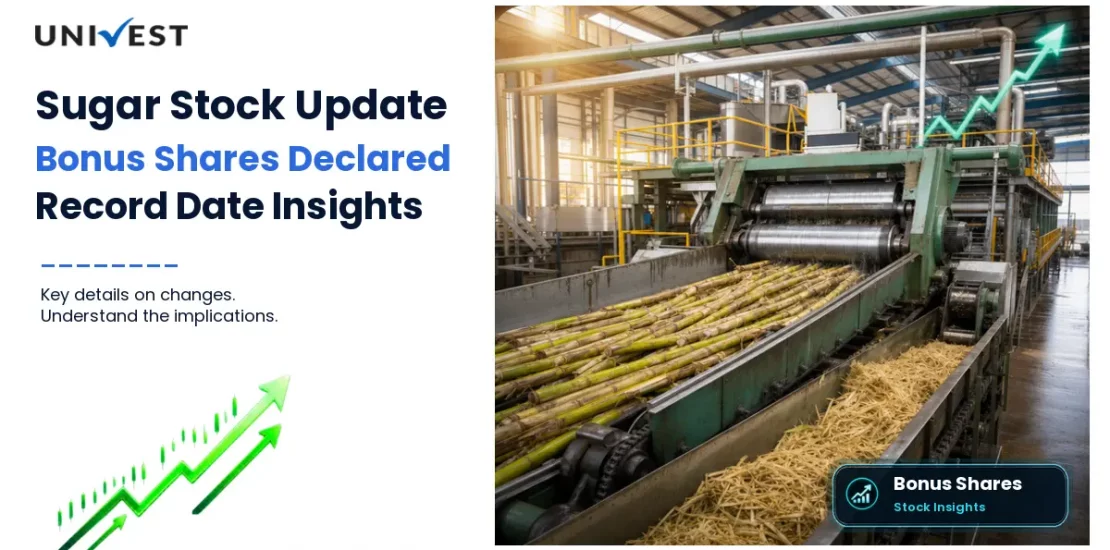
Sugar stock bonus shares (headline of 13 Oct 2026): the board declared 10 bonus shares for every one share held. The company name, record date and new authorised capital could not be verified, so none is given. Each holder’s share count becomes 11 times the old count.
Quick Answer
A sugar company board has declared 10 bonus shares for every one share held, so a holder of 100 shares would receive 1,000 bonus shares and own 1,100 in total. A bonus issue does not change the company’s market value, so the share price adjusts to about one eleventh of its earlier level on the ex-date (my calculation). I could not verify the company name, the record date or the new authorised capital, so this guide explains how they work and where to find them in the filing. Check the exchange announcement for the record date, the ex-date and the authorised capital before you act on the sugar stock bonus shares.
A sugar industry company has announced a bonus issue of 10 shares for every share held by eligible shareholders. The headline calls it 1:10 and the text describes 10 new shares for each existing share, which is a 10 for 1 bonus. The board meeting outcome also covered the record date and a change in authorised capital.
This guide explains how sugar stock bonus shares work, what the 1:10 ratio means, how the price adjusts, why authorised capital must rise, how the record date decides eligibility and what you should check. Every figure below is a calculation from the ratio, and I do not name the company.
Anyone searching for sugar stock bonus shares should first confirm the company name and the filing, because the exact dates are in the exchange announcement.
Click Here – Get Free Investment Predictions
How the Sugar Stock Bonus Shares Ratio Works
The headline writes the ratio as 1:10, but the sentence below it says the board declared 10 bonus shares for every one share held. In the usual convention that is a 10:1 bonus, and it means each existing share becomes 11 shares.
| Shares held before | Sugar stock bonus shares received | Total after the bonus |
|---|---|---|
| 1 | 10 | 11 |
| 10 | 100 | 110 |
| 100 | 1,000 | 1,100 |
| 500 | 5,000 | 5,500 |
If the company meant one bonus share for every ten held, the table would be very different, so confirm the ratio in the filing. Sugar stock bonus shares at 10 for 1 would raise the share count 11 times, which is rare for a sugar stock.
Risk: A mistaken reading of the ratio of sugar stock bonus shares changes the whole calculation. Always read the exchange filing, which states the number of sugar stock bonus shares for each share held.
Screen sugar stocks on the Univest Screener
What Happens to the Share Price After the Bonus
A bonus issue moves reserves into share capital and does not bring in any new money. The company’s market value stays the same, so the price is divided by the new share count on the ex-date. With a 10 for 1 bonus, the price falls to about one eleventh (my calculation).
| Price before ex-date (Rs) | Adjusted price (Rs) | Value of 100 shares before | Value of 1,100 shares after |
|---|---|---|---|
| 1,100 | 100 | 1,10,000 | 1,10,000 |
| 550 | 50 | 55,000 | 55,000 |
| 220 | 20 | 22,000 | 22,000 |
The value of your holding of sugar stock bonus shares does not change on the ex-date, because the extra shares are offset by the lower price. Earnings per share, book value per share and dividend per share are also divided by 11 for the new share count.
Sugar stock bonus shares can still move the stock in the market. A lower price per share attracts small investors, and trading volume can rise, but that is sentiment and not new value.
Why Authorised Capital Changes for Sugar Stock Bonus Shares
A company can issue shares only up to its authorised capital. Sugar stock bonus shares are paid for by turning reserves into paid-up capital, so a 10 for 1 bonus raises paid-up capital by 10 times the old level. If the new paid-up capital would cross the authorised limit, the company must first raise its authorised capital, which needs the approval of shareholders and an amended memorandum.
| Step | What happens |
|---|---|
| Board meeting | The board approves the bonus ratio, the use of reserves and an increase in authorised capital |
| Shareholder approval | Shareholders approve the capital increase and the bonus, by postal ballot or at a general meeting |
| Record date | The company fixes the date that decides who receives the bonus shares |
| Allotment | Sugar stock bonus shares are credited to demat accounts within the timeline set by SEBI rules |
| Listing | The new shares get exchange approval and start trading |
The headline mentions a change in authorised capital but I could not verify the new figure. The filing will give the old and new authorised capital and the number of shares it divides into.
Download the Univest iOS App or Univest Android App to track corporate actions such as bonus issues.
Record Date and Ex-Date Rules for the Bonus Issue
Only shareholders whose names are on the company’s books on the record date receive the sugar stock bonus shares. With T+1 settlement, a buyer must hold the shares before the ex-date, which is usually the same day as the record date, so the last day to buy is the trading day before it (my calculation).
| Question | Answer |
|---|---|
| Who gets sugar stock bonus shares? | Holders on the record date, as shown in demat accounts |
| Last day to buy? | The trading day before the ex-date; confirm on the exchange |
| Is any tax payable when bonus shares arrive? | No tax is payable on receipt; the cost of sugar stock bonus shares is treated as nil and tax applies when you sell |
| When does the holding period start? | From the date of allotment of the sugar stock bonus shares |
I could not find the record date for this company, so I do not give one. Use the exchange announcement and the company’s disclosure.
Risk: Do not buy a stock only for the bonus. The price adjusts on the ex-date, and the business results and the sugar cycle decide the long term return.
What to Check Before Buying a Sugar Stock After a Bonus Announcement
- The company name, the bonus ratio, the record date and the ex-date from the exchange filing.
- Whether the authorised capital increase and the bonus need shareholder approval, and when it is due.
- Sugar prices, ethanol blending and cane price policy, which drive earnings.
- Debt levels and the interest burden, because sugar companies carry working capital loans.
- Past results, so that you buy the business and not the bonus news.
What to Watch Next for the Sugar Stock Bonus Shares
- The record date and ex-date notice from the exchange.
- Shareholder approval of the authorised capital change.
- Allotment and listing of the new shares.
- The company’s next quarterly results.
Conclusion
Sugar stock bonus shares of 10 for every one held raise each holding to 11 times its size, but the price adjusts to about one eleventh and the value stays the same. I could not identify the company, so confirm the name, the record date and the authorised capital from the filing. Decide on the business and your own research and not on the bonus alone.
Disclaimer: Data and figures in this article are sourced from publicly available information. These may or may not be accurate. Please verify all data with the official NSE (nseindia.com) and BSE (bseindia.com) websites before making any investment decision. Investments in securities are subject to market risk. This content is for educational purposes only and is not investment advice by Univest (SEBI RA INH000013776).
Frequently Asked Questions
Which sugar stock declared the sugar stock bonus shares?
Ans. The headline does not name the company in the part I could verify, and I could not confirm it from other sources. Check the original report and the exchange announcement.
What does 1:10 mean for the sugar stock bonus shares?
Ans. The text below the headline says 10 bonus shares for every one share held, so each share becomes 11 shares. Confirm the ratio in the filing.
What happens to the share price after the bonus?
Ans. It is adjusted on the ex-date. With 10 bonus shares for every one held, the price falls to about one eleventh (my calculation) and the value of your holding stays the same.
Why does a bonus issue need a change in authorised capital?
Ans. Bonus shares turn reserves into paid-up capital. If the new paid-up capital would exceed the authorised limit, the company must raise the limit first.
What is the record date for the sugar stock bonus shares?
Ans. I could not verify it. The record date decides who is eligible, and it is stated in the exchange announcement.
Is tax payable on sugar stock bonus shares?
Ans. No tax is payable when sugar stock bonus shares are received. Their cost is treated as nil, and capital gains tax applies when you sell, at the rates in force.
Do bonus shares create value?
Ans. No. The market value of the company stays the same, and per share measures such as earnings and book value are divided by the new share count.
Should I buy the sugar stock for the bonus?
Ans. This article does not constitute investment advice. Consult a SEBI-registered financial advisor before you buy, sell or hold any sugar stock.
