
Recyclekaro Partners With TMK for Recycling Facility in Uzbekistan
- September 10, 2026
- Posted by: Harsh Piplani
- Category: News
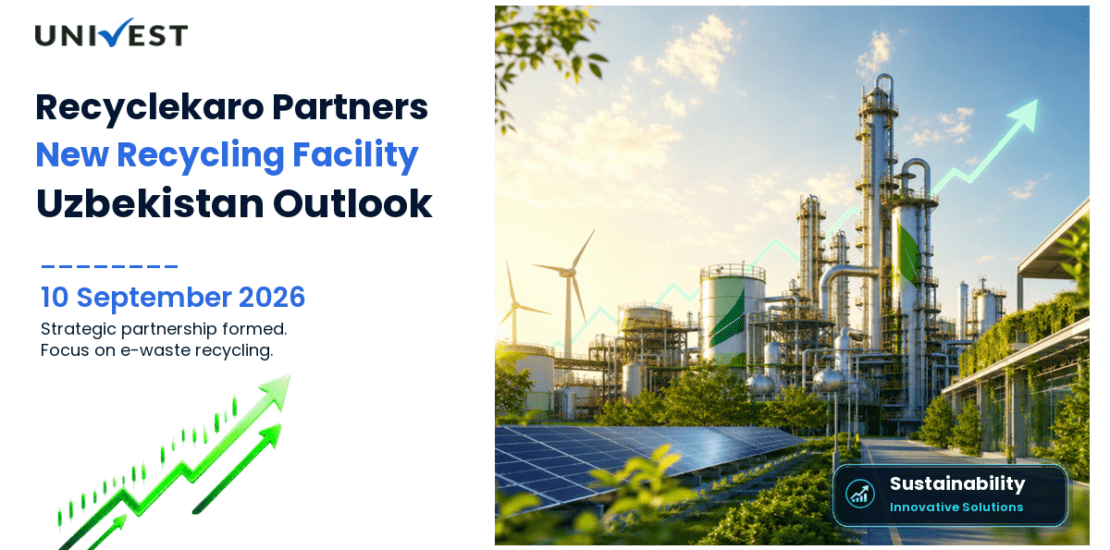
Recyclekaro will build an e-waste and battery recycling facility in Uzbekistan through a partnership with TMK.
Quick Answer
The Recyclekaro TMK Uzbekistan partnership is a strategic collaboration between Indian recycling firm Recyclekaro and the Uzbekistan Technological Metals Complex to build an e-waste and lithium-ion battery recycling facility with critical mineral recovery capabilities. Under the Recyclekaro TMK Uzbekistan project, the facility will initially serve as a critical metal recovery hub for Uzbekistan before expanding in a second phase to process e-waste and batteries and recover critical minerals from across Central Asia, with Recyclekaro contributing technology, project development and operational expertise.
Recyclekaro TMK Uzbekistan is more than a one-line partnership announcement, it is a joint venture that pairs an Indian recycling company with a track record in lithium-ion battery recovery against Uzbekistan’s state-backed push to become a global hub for critical raw materials. The timing is not incidental either, arriving weeks after a diplomatic upgrade between the two countries specifically named critical minerals as an area for closer cooperation.
This article looks at what the Recyclekaro TMK Uzbekistan joint venture actually involves, what each partner brings to the table, and the broader context that explains why this deal is happening now.
Click Here – Get Free Investment Predictions
What the Recyclekaro TMK Uzbekistan Deal Actually Is
Recyclekaro and TMK have agreed to establish a joint venture facility in Uzbekistan for the recycling of e-waste and end-of-life lithium-ion batteries, along with critical mineral recovery, built from the ground up rather than through an existing asset. In its first phase, the Recyclekaro TMK Uzbekistan facility will function as a critical metal recovery hub serving Uzbekistan domestically, providing end-to-end recovery capability from collection through to critical metal extraction. A second phase would expand the facility to process e-waste and batteries and recover critical minerals from across Central Asia, not just within Uzbekistan’s borders. Feasibility studies to determine the facility’s scale are already underway, with capacity figures expected to be announced once that work is complete.
The India-Uzbekistan Backdrop Behind the Timing
The Recyclekaro TMK Uzbekistan agreement follows Prime Minister Narendra Modi’s state visit to Tashkent, during which India and Uzbekistan elevated their bilateral relationship to a Comprehensive Strategic Partnership. Critical minerals, trade, investment and energy transition were specifically identified during that visit as priority areas for deeper cooperation, including mineral processing and recycling initiatives. Read against that backdrop, Recyclekaro TMK Uzbekistan is one of the first concrete commercial outcomes of that diplomatic groundwork, rather than a standalone corporate deal.
What Recyclekaro Brings: An Established Indian Recycler
Recyclekaro is not a new entrant experimenting abroad for the first time. Founded in 2010 and based in Navi Mumbai, the company operates India’s largest lithium-ion battery recycling facility, a 17-acre plant in Palghar, recovering over 90 percent of critical elements such as lithium, cobalt, nickel and manganese at more than 99 percent purity. It is one of only four companies registered as a lithium-ion battery recycler on India’s official Extended Producer Responsibility portal, alongside names such as Attero and Lohum. Recyclekaro has worked with corporate partners including Bajaj Auto and Tata Motors across more than 1,350 projects and over 1,200 collection points, giving the Recyclekaro TMK Uzbekistan venture a partner with genuine operating history rather than an unproven model. That operating history is precisely what distinguishes Recyclekaro TMK Uzbekistan from a purely speculative overseas expansion.
- Recycling technology: Recyclekaro’s hydrometallurgical extraction process, developed over more than a decade of in-house research.
- Project development: experience building and scaling a recycling facility from the ground up, as it did at Palghar.
- Plant operations: day-to-day operational expertise in running a large-scale recovery facility.
Explore More Stocks and Market News on the Screener
What TMK Brings: Uzbekistan’s Critical Minerals Infrastructure
The Uzbekistan Technological Metals Complex is a state-backed enterprise established in 2024 under an initiative led by President Shavkat Mirziyoyev, built around what TMK calls a Mine-Metal-Market model that integrates exploration, processing, research and manufacturing into one value chain. TMK currently oversees more than 100 projects across over 25 strategic mineral commodities, including tungsten, molybdenum, lithium, graphite, cobalt, nickel and rare earths, and has already signed cooperation agreements with partners in the United States, European Union, Germany, South Korea and China. For the Recyclekaro TMK Uzbekistan venture, TMK effectively supplies the local infrastructure, regulatory backing and integration into Uzbekistan’s broader critical minerals ecosystem.
Download the Univest iOS App or Univest Android App to track market news on the go
Why This Matters for Critical Mineral Supply Chains
Countries and companies worldwide are trying to reduce dependence on a small number of processing hubs for critical minerals used in batteries, electronics and clean energy equipment. Recyclekaro TMK Uzbekistan fits into that broader shift toward urban mining, recovering metals from waste rather than relying solely on fresh extraction, a theme Recyclekaro Managing Director Rajesh Gupta pointed to directly, saying advanced recycling and urban mining will play a critical role in securing strategic materials as supply chains are rebuilt to be more resilient. India itself generates about 1.71 million metric tonnes of e-waste annually, the third highest in the world, with only around 40 percent currently recycled, underlining the scale of the recovery opportunity Recyclekaro is now trying to replicate abroad.
What Happens Next for Recyclekaro TMK Uzbekistan
- Feasibility studies to determine the facility’s scale, location specifics and viability are being completed.
- Capacity figures and a firmer project timeline are expected once that assessment is finalised.
- Phase one construction would focus on Uzbekistan-only critical metal recovery from collection through to output.
- Phase two would expand processing to e-waste and batteries sourced from across Central Asia, not just Uzbekistan.
Conclusion
Recyclekaro TMK Uzbekistan pairs a genuinely established Indian recycler with Uzbekistan’s state-backed critical minerals infrastructure, arriving on the back of a real diplomatic push rather than as an isolated corporate announcement. The venture is still at the feasibility stage, so capacity and firm timelines remain unconfirmed, but the combination of Recyclekaro’s operating track record and TMK’s Mine-Metal-Market ecosystem gives the project a more concrete foundation than a typical early-stage MoU.
Disclaimer: Data and figures in this article are sourced from publicly available information and may change as trading continues through the day. Please verify all data independently before making any investment decision. Investments in securities are subject to market risk. This content is for educational purposes only and is not investment advice by Univest (SEBI RA INH000013776).
FAQs
What is the Recyclekaro TMK Uzbekistan joint venture?
Ans. It is a joint venture between Indian recycler Recyclekaro and the Uzbekistan Technological Metals Complex to build a new e-waste and lithium-ion battery recycling facility with critical mineral recovery capability in Uzbekistan.
Is Recyclekaro TMK Uzbekistan an existing facility or a new one?
Ans. It is a new facility being developed from the ground up, not an acquisition of an existing plant.
What track record does Recyclekaro have before this deal?
Ans. Recyclekaro, founded in 2010, operates India’s largest lithium-ion battery recycling facility in Palghar, recovers over 90 percent of critical elements at above 99 percent purity, and is one of only four EPR-registered lithium-ion battery recyclers in India, a background it now brings to Recyclekaro TMK Uzbekistan.
What is the Uzbekistan Technological Metals Complex?
Ans. TMK is a state-backed enterprise established in 2024 that runs Uzbekistan’s critical minerals strategy through a Mine-Metal-Market model spanning over 100 projects across more than 25 mineral commodities, and is Recyclekaro’s partner in the Recyclekaro TMK Uzbekistan venture.
Why is this deal happening now?
Ans. Recyclekaro TMK Uzbekistan follows Prime Minister Modi’s state visit to Tashkent, during which India and Uzbekistan elevated relations to a Comprehensive Strategic Partnership that specifically named critical minerals as a cooperation priority.
What are the two phases of the Recyclekaro TMK Uzbekistan project?
Ans. Phase one focuses on critical metal recovery within Uzbekistan alone; phase two would expand to process e-waste and batteries and recover minerals from across Central Asia.
Has the facility’s capacity been finalised?
Ans. No, feasibility studies for Recyclekaro TMK Uzbekistan are still underway to determine scale and viability, with capacity details expected once that work is complete.
Why does India care about recycling critical minerals abroad?
Ans. India generates about 1.71 million metric tonnes of e-waste annually, the third highest in the world, with only around 40 percent currently recycled, making urban mining and recovery technology a strategic priority both at home and, through ventures like Recyclekaro TMK Uzbekistan, abroad.
