
Bharat Heavy Electricals (BHEL) Share: Pros and Cons Every Investor Must Know in 2026
- August 7, 2026
- Posted by: Neeraj Pandey
- Category: News
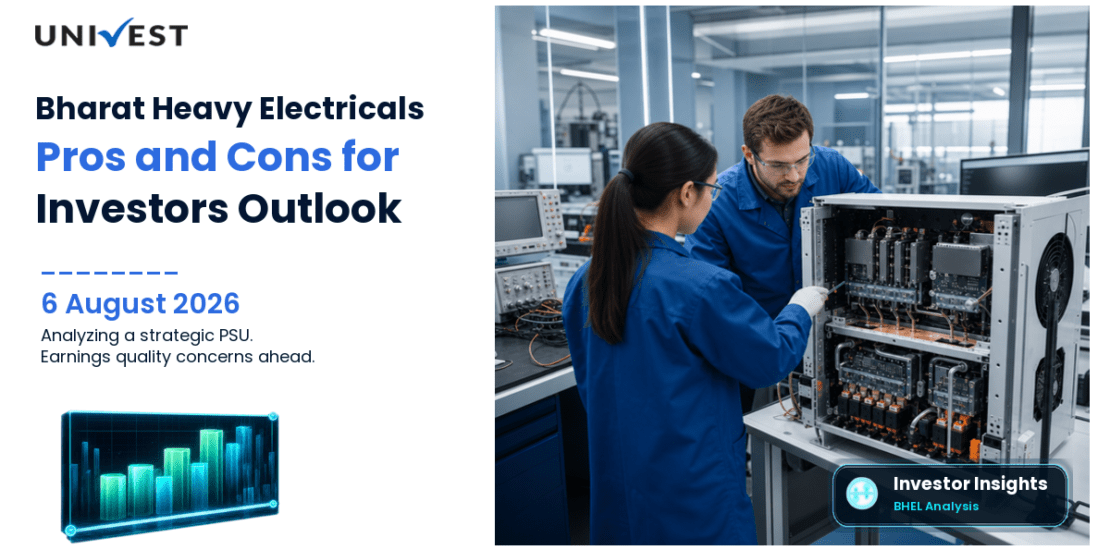
Bharat Heavy Electricals (BHEL) share CMP approx Rs 408. 52W High Rs 490. Market Cap approx Rs 1,42,904 Cr. PE 58.71x.
The Bharat Heavy Electricals (BHEL) share is a listed investment in India’s Power Equipment PSU sector. Investors must weigh its strengths in india’s only large power plant equipment manufacturer — strategic psu against the risks of pe of 58.7x is very high for 6 percent roe — earnings quality challenge when making allocation decisions.
Click Here – Get Free Investment Predictions
About Bharat Heavy Electricals (BHEL)
Bharat Heavy Electricals (BHEL) is a listed Indian company in the Power Equipment PSU sector with NSE ticker BHEL, offering investors exposure to key themes in India’s economic growth.
Key Financial Snapshot: Bharat Heavy Electricals (BHEL) Share
| Parameter | Details |
|---|---|
| Company | Bharat Heavy Electricals (BHEL) |
| NSE Symbol | BHEL |
| Sector | Power Equipment PSU |
| CMP (Approx) | Rs 408 |
| 52-Week High | Rs 490 |
| 52-Week Low | Rs 320 |
| Market Cap | Rs 1,42,904 Cr |
| P/E Ratio | 58.71 |
Data approx. 6 Aug 2026. Verify on nseindia.com.
Pros of Investing in Bharat Heavy Electricals (BHEL) Share
1. India’s Only Large Power Plant Equipment Manufacturer — Strategic PSU
BHEL is India’s only large-scale manufacturer of power plant equipment including steam turbines, boilers, generators, transformers, and power electronics for thermal, nuclear, and renewable energy projects. This strategic monopoly position in domestic power equipment manufacturing provides BHEL with assured government business for India’s power capacity expansion.
2. Rs 1 Lakh Crore Order Book — Decade of Revenue Visibility
BHEL has an order book exceeding Rs 1 lakh crore — approximately 3 to 4 times its annual revenue — providing decade-long revenue visibility from ordered but not yet executed power project contracts. This order book includes supercritical thermal units, nuclear island equipment, and renewable energy project deliveries.
3. Green Energy Transition — Solar Modules, Energy Storage, and Green Hydrogen
BHEL is expanding into solar PV module manufacturing, energy storage systems, and green hydrogen electrolyser production, positioning itself for India’s clean energy transition. These new product lines could provide significant revenue as India executes its 500 GW renewable energy target.
4. Nuclear Power Programme Involvement — BHEL’s Unique Nuclear Equipment Capability
BHEL is the designated supplier for turbine-generator sets for India’s nuclear power programme (NPCIL reactors), providing a unique revenue stream from India’s nuclear energy expansion that no private sector company can access without BHEL’s established nuclear equipment certification.
5. PSU Maharatna Status Providing Capital Access and Government Project Priority
BHEL’s Maharatna PSU status provides it with government project priority, access to sovereign-backed financing, and the institutional credibility required for large infrastructure contracts in India and export markets.
Cons of Investing in Bharat Heavy Electricals (BHEL) Share
1. PE of 58.7x Is Very High for 6 Percent ROE — Earnings Quality Challenge
At approximately 59x PE with ROE of only 6.12 percent, the BHEL share appears very expensive for current earnings delivery. The depressed ROE reflects intense competition from Chinese power equipment manufacturers for international contracts and legacy cost structures from its large PSU workforce.
2. ROE of 6 Percent Reflects PSU Inefficiency and Competition From Chinese Equipment
BHEL’s 6 percent ROE is far below the 15 percent quality benchmark, reflecting PSU workforce overhead, import competition from Chinese power equipment that undercuts BHEL’s pricing on international contracts, and working capital intensive project execution that ties up capital inefficiently.
3. Chinese Equipment Competition in Power Plants — Pricing Pressure
BHEL faces intense competition from Chinese power equipment manufacturers like Shanghai Electric and Dongfang Electric whose lower manufacturing costs enable significantly more aggressive pricing on both domestic and international thermal power project bids. This competition has historically prevented BHEL from winning international contracts at profitable margins.
4. Order Book Execution Delays — Project Delivery Consistently Slower Than Contracted
BHEL’s order book execution has been chronically slower than contracted timelines, creating penalties, customer dissatisfaction, and working capital escalation on delayed projects. This execution quality concern limits BHEL’s ability to command premium pricing even for technically superior equipment.
Use the Univest Screener to Analyse Stocks for Free
Is Bharat Heavy Electricals (BHEL) Share a Good Investment in 2026?
BHEL share reflects India’s strategic power equipment capability at very expensive PE relative to current ROE quality. The green energy pivot and large order book are genuine positives, but 59x PE for 6 percent ROE is difficult to justify fundamentally. Wait for ROE improvement before meaningful allocation.
Key Risks of Bharat Heavy Electricals (BHEL) Share
- Chinese power equipment manufacturers winning large domestic thermal project tenders on price
- Green energy product lines failing to reach commercial scale within 3 to 5 year horizon
- Large project delivery delays creating customer penalties and working capital escalation
- Government reducing thermal power investment in favour of renewable accelerating BHEL order book erosion
Conclusion
The Bharat Heavy Electricals (BHEL) share offers india’s only large power plant equipment manufacturer — strategic psu as its primary investment case. Weigh risks around pe of 58.7x is very high for 6 percent roe — earnings quality challenge. Use Univest Screener and consult a SEBI-registered advisor.
Download the Univest iOS App or Univest Android App to track Bharat Heavy Electricals (BHEL) share price live.
Disclaimer: Data from publicly available sources. May not be accurate. Verify on nseindia.com and bseindia.com. Not investment advice by Univest (SEBI RA INH000013776).
Frequently Asked Questions on Bharat Heavy Electricals (BHEL) Share
What are the main pros of BHEL share?
Ans. BHEL share is India’s only power plant equipment manufacturer with strategic PSU monopoly, Rs 1 lakh crore-plus order book providing decade of revenue visibility, green energy transition expansion into solar, storage, and hydrogen, unique nuclear equipment capability for NPCIL programme, and Maharatna PSU status providing capital and project priority.
What are the key risks of BHEL share?
Ans. BHEL share faces PE of 59x very high for 6 percent ROE, Chinese power equipment competition on international and domestic pricing, chronic order book execution delays creating penalties, and green energy product commercialisation requiring years before meaningful revenue. Monitor quarterly order wins and execution progress.
Is BHEL share a good investment in 2026?
Ans. BHEL share is strategically important but expensive at 59x PE for 6 percent ROE. Wait for ROE improvement trajectory before meaningful allocation. Consult a SEBI-registered advisor. This is not investment advice.
What is the 52-week range of BHEL share?
Ans. BHEL share has a 52-week high of approximately Rs 490 and a 52-week low of approximately Rs 320. Verify current data on NSE India at nseindia.com.
What power equipment does BHEL manufacture?
Ans. BHEL manufactures turbine-generator sets (steam, gas, hydro), boilers (subcritical, supercritical, ultra-supercritical), transformers, switchgear, control systems, solar modules, and nuclear island equipment for India’s power generation sector. BHEL’s product range covers thermal, hydro, nuclear, wind, and solar power plant equipment — making it India’s most complete domestic power equipment manufacturer.
What is BHEL’s role in India’s renewable energy transition?
Ans. BHEL is manufacturing solar PV modules at its Bengaluru facility to supply to government solar projects under the Production Linked Incentive (PLI) scheme for solar manufacturing. It is also developing green hydrogen electrolyser technology and energy storage systems. These new product lines position BHEL for India’s renewable transition beyond its core thermal and nuclear power equipment business.
