
10 Percent Section 122 Tariff Ends on 24 July 2026: What the Expiry Means for Indian Exports and Trade Talks
- July 24, 2026
- Posted by: Neeraj Pandey
- Category: News
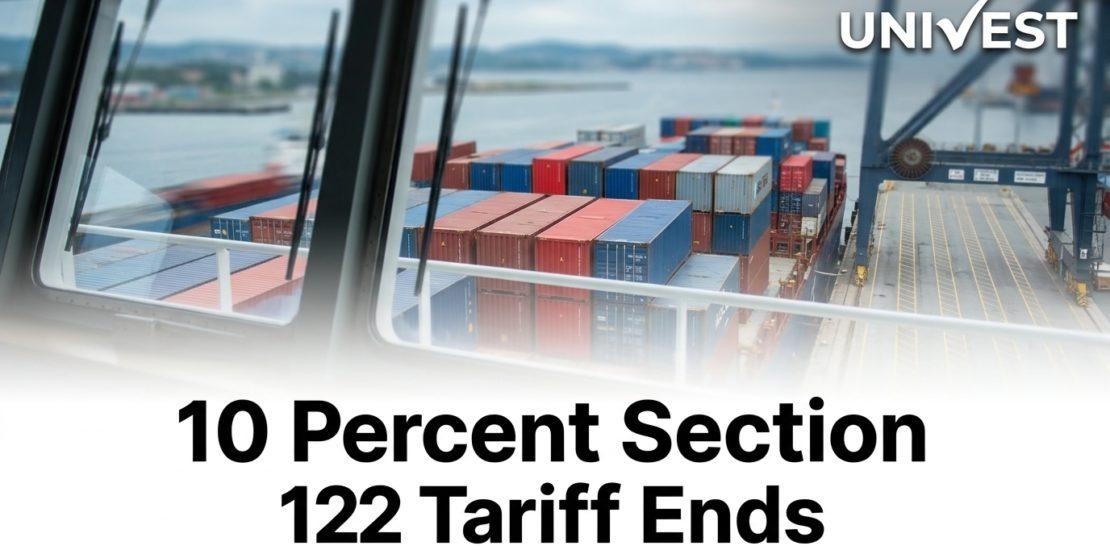
10 percent Section 122 tariff expires 24 July 2026. India US interim trade agreement talks ongoing. Deal could form basis of broader Bilateral Trade Agreement. Exporters await clarity.
The 10 percent Section 122 tariff imposed by the United States ends on 24 July 2026, a deadline that arrives against the backdrop of ongoing India US negotiations for an interim trade agreement. The Section 122 tariff expiry is being watched closely by exporters, since the outcome could eventually form the basis of a broader Bilateral Trade Agreement between the two countries.
For Indian markets, the Section 122 tariff timeline adds a layer of uncertainty at a moment when global trade tensions are already resurfacing and a renewed trade war narrative is lifting the dollar and inflation expectations worldwide.
Click Here – Get Free Investment Predictions
What Is the Section 122 Tariff
Section 122 of the US Trade Act of 1974 allows an American president to impose temporary tariffs of up to 15 percent for a maximum of 150 days to address large balance of payments deficits, without requiring congressional approval. The current 10 percent Section 122 tariff on imports was applied under this authority, and its statutory clock runs out on 24 July.
| Parameter | Detail |
|---|---|
| Tariff rate | 10 percent |
| Legal basis | Section 122, US Trade Act of 1974 |
| Maximum duration | 150 days without Congress approval |
| Expiry date | 24 July 2026 |
| Parallel track | India US interim trade agreement talks |
| Long term goal | Bilateral Trade Agreement (BTA) |
Section 122 Tariff Expiry and the India US Trade Agreement
The Section 122 tariff uncertainty comes as New Delhi and Washington negotiate an interim trade deal that could later expand into a comprehensive Bilateral Trade Agreement. An interim pact would aim to settle tariff lines on key Indian export categories and restore predictability for businesses on both sides.
If the tariff lapses without replacement, Indian exporters get immediate relief on affected shipments. However, Washington retains other tools, including Section 301 and national security provisions, so the durability of any relief depends on the broader negotiation.
Which Indian Exports Are Affected by the Section 122 Tariff
The Section 122 tariff has weighed on price sensitive, labour intensive export categories where margins are thin. Textiles and apparel, gems and jewellery, leather goods, engineering goods, auto components and seafood exporters have felt the pinch, since a 10 percent duty can erase the competitive edge against rivals from Vietnam, Bangladesh and Mexico.
Pharmaceuticals and IT services have been relatively insulated, as medicines enjoy carve outs in most tariff actions and services are outside the scope of goods tariffs. Exporters have reportedly front loaded shipments ahead of deadline dates to manage duty exposure.
Screen export oriented stocks on the Univest Screener
Market Impact of the Section 122 Tariff Deadline
Trade policy headlines rarely move the broad market alone, but they shape sector rotation. Clarity on the Section 122 tariff could support textile, engineering and auto component stocks that derive meaningful revenue from the US market.
Conversely, a hard line outcome would add pressure on an already nervous market, with the Nifty 50 facing headwinds from 100 dollar crude and rising US yields. A constructive interim deal announcement would be an incremental positive for sentiment and the rupee.
Download the Univest iOS App or Univest Android App to track export focused stocks and trade policy news.
Conclusion
The 10 percent Section 122 tariff ends on 24 July 2026, and its expiry is intertwined with ongoing India US negotiations for an interim trade agreement that may anchor a future Bilateral Trade Agreement. Labour intensive exporters stand to gain the most from relief, while the broader market awaits clarity. Investors should watch official announcements closely and consult a SEBI registered advisor before positioning around trade policy outcomes.
Disclaimer: Data and figures in this article are sourced from publicly available information. These may or may not be accurate. Please verify all data with the official NSE (nseindia.com) and BSE (bseindia.com) websites before making any investment decision. Investments in securities are subject to market risk. This content is for educational purposes only and is not investment advice by Univest (SEBI RA INH000013776).
Frequently Asked Questions FAQs
What is the Section 122 tariff?
Ans. The Section 122 tariff is a temporary 10 percent duty imposed by the United States under Section 122 of the US Trade Act of 1974, which allows tariffs of up to 15 percent for a maximum of 150 days to address balance of payments concerns without congressional approval.
When does the Section 122 tariff end?
Ans. The 10 percent Section 122 tariff ends on 24 July 2026, when its statutory 150 day window expires. Any extension beyond this would require action by the US Congress or the use of a different legal authority.
How does the tariff expiry affect Indian exports?
Ans. Expiry would provide immediate duty relief on affected Indian shipments, helping labour intensive sectors such as textiles, gems and jewellery, leather, engineering goods and seafood regain price competitiveness in the US market.
What is the India US interim trade agreement?
Ans. It is a proposed limited trade deal currently under negotiation between New Delhi and Washington that would settle tariffs on key product lines. Officials suggest it could eventually form the basis of a broader Bilateral Trade Agreement covering wider market access.
Which sectors are most exposed to US tariff decisions?
Ans. Textiles and apparel, gems and jewellery, leather goods, auto components, engineering goods and seafood are most exposed, since the US is a major buyer and a 10 percent duty significantly erodes thin export margins in these categories.
How should investors respond to trade policy news?
Ans. Investors should avoid reacting to individual headlines and instead track confirmed policy outcomes, company level US revenue exposure and management commentary. Consulting a SEBI registered advisor is recommended before making sector bets on trade developments.
