
ITC Hotels Q1 Results FY27: Net Profit Falls 43% to Rs 180 Crore as Revenue Declines 25.3%
- July 16, 2026
- Posted by: Ankit Jaiswal
- Category: News
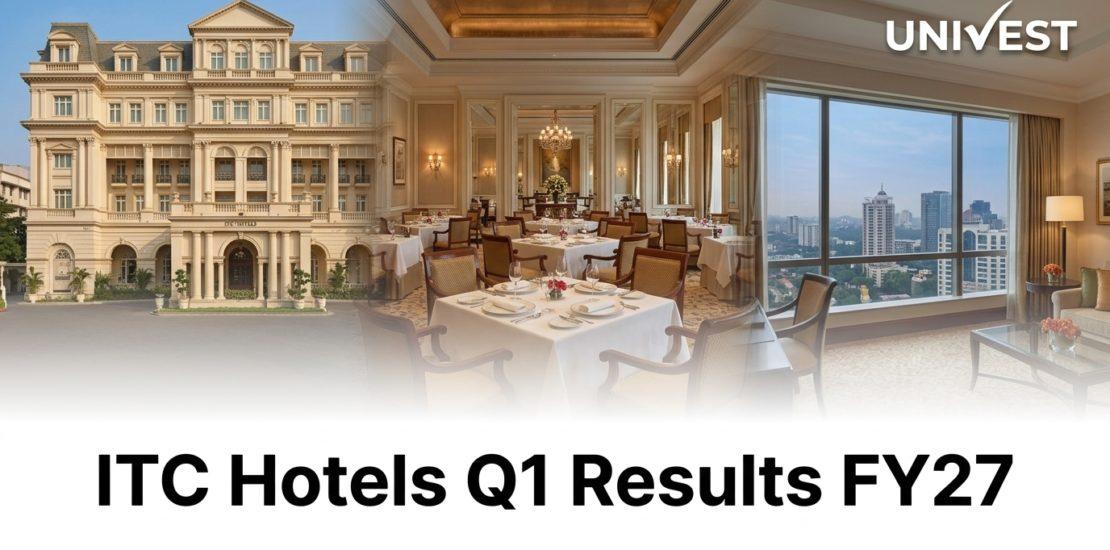
ITC Hotels Q1 FY27: net profit Rs 180 Cr, down 43% QoQ from Rs 316 Cr. Revenue Rs 936 Cr, down 25.3% QoQ. EBITDA Rs 292.3 Cr, down 37.3%, margin 31.2% vs 37.2%. Stock down 5.11% at Rs 174.12.
ITC Hotels Q1 results FY27 were announced on Thursday, 16 July 2026, with the hospitality company reporting a net profit of Rs 180 crore, down 43% from Rs 316 crore in the preceding March quarter. Revenue in the ITC Hotels Q1 results FY27 declined 25.3% sequentially to Rs 936 crore from Rs 1,253.7 crore, while EBITDA fell a sharper 37.3% to Rs 292.3 crore, with the EBITDA margin contracting to 31.2% from 37.2%.
Shares of ITC Hotels fell 5.11% to close at Rs 174.12, as the market reacted to the significant sequential decline across every key metric, a pattern consistent with the hospitality industry’s seasonal softness in the June quarter.
Click Here – Get Free Investment Predictions
ITC Hotels Q1 results FY27 Financial Highlights
The June quarter showed a steep sequential decline across revenue, EBITDA and net profit, a combination central to the ITC Hotels Q1 results FY27. The table below summarises the numbers against the preceding March quarter.
| Metric | Q1 FY27 | Q4 FY26 | QoQ Change |
|---|---|---|---|
| Revenue | Rs 936 Cr | Rs 1,253.7 Cr | -25.3% |
| EBITDA | Rs 292.3 Cr | Rs 466 Cr | -37.3% |
| EBITDA Margin | 31.2% | 37.2% | -600 bps |
| Net Profit (PAT) | Rs 180 Cr | Rs 316 Cr | -43% |
The scale of sequential decline in the ITC Hotels Q1 results FY27, with EBITDA falling nearly 1.5 times faster than revenue, is broadly consistent with the hospitality industry’s seasonal pattern, where the June quarter typically sees softer occupancy and average room rates compared with the stronger October to March period.
ITC Hotels Q1 results FY27 Performance Analysis
Get Personalised Guidance from a SEBI-Registered Investment Advisor
The sequential decline across every metric in the ITC Hotels Q1 results FY27 reflects the well-documented seasonality of the Indian hospitality industry, where the June quarter, coinciding with the pre-monsoon and monsoon period, typically sees softer leisure and business travel demand compared with the peak October to March season.
EBITDA margin contracting to 31.2% from 37.2% quarter on quarter shows that fixed costs in the hotel business, including staffing, maintenance and utilities, did not scale down proportionately with the softer revenue, a common pattern in hospitality where operating leverage works in both directions.
Investors reading the ITC Hotels Q1 results FY27 should weigh this quarter’s numbers against the same period in the prior year rather than the preceding quarter alone, since the sequential comparison against a seasonally stronger March quarter can overstate the extent of any underlying business weakness.
ITC Hotels Q1 results FY27: Key Business Factors
1. Seasonal Hospitality Demand Pattern
The sequential decline this quarter is largely consistent with the hospitality industry’s well-known seasonality, where the June quarter typically underperforms the stronger October to March peak season.
2. Operating Leverage Working in Reverse
EBITDA margin contracting more than the revenue decline in the ITC Hotels Q1 results FY27 shows that the largely fixed cost structure in hotel operations did not scale down proportionately with softer seasonal demand.
3. ITC Group Brand and Distribution
As part of the ITC group’s hospitality portfolio, the company continues to benefit from established brand recognition and distribution channels, even amid typical seasonal softness.
Dividend Details
No new dividend was announced specifically alongside the ITC Hotels Q1 results FY27. Investors should watch for the company’s dividend history and future board meeting announcements to gauge its capital allocation approach going forward.
ITC Hotels Q1 results FY27 Outlook for the Full Year
Given the well-established seasonal pattern in Indian hospitality, investors should watch for a recovery in the September and December quarters as the industry moves toward its stronger travel season. Tracking occupancy and average room rate trends, along with year on year comparisons rather than purely sequential ones, will offer a clearer picture of the underlying business trajectory through FY27.
ITC Hotels Stock Performance After the Q1 Results
Download the Univest iOS App or Univest Android App to track ITC Hotels live share price and upcoming quarterly results.
ITC Hotels share price fell 5.11% to close at Rs 174.12 on the NSE after the ITC Hotels Q1 results FY27, reflecting market concern over the scale of the sequential decline despite its largely seasonal nature.
As a hospitality sector stock, the counter can see pronounced price reactions to quarterly results, and this quarter’s decline, while seasonally expected, still triggered a sharp sell-off, suggesting the market may have anticipated a smaller sequential drop.
Key Risks
Investors going through the fine print of the ITC Hotels Q1 results FY27 should also weigh the following risks.
1. Seasonal Revenue Volatility
The scale of decline in the ITC Hotels Q1 results FY27 highlights how seasonal the hospitality business can be, making quarter to quarter comparisons less meaningful than year on year trends for assessing underlying performance.
2. Margin Sensitivity to Occupancy
With a largely fixed cost base, hotel operating margins are highly sensitive to occupancy levels, meaning any prolonged demand softness could disproportionately affect profitability.
3. Competitive Hospitality Market
The Indian hospitality industry remains competitive, with multiple established and emerging hotel chains competing for both leisure and business travel demand across key markets.
Conclusion
ITC Hotels Q1 results FY27 show a steep sequential decline, with PAT down 43% to Rs 180 crore and revenue down 25.3% to Rs 936 crore, alongside EBITDA margin contraction to 31.2% from 37.2%, a pattern broadly consistent with the hospitality industry’s seasonal softness in the June quarter. The scale of the sequential fall is the central talking point this quarter, though the seasonal context matters for interpretation. Investors reading the ITC Hotels Q1 results FY27 should track year on year trends and consult a SEBI-registered advisor before acting on the numbers.
Disclaimer: Data and figures in this article are sourced from publicly available information. These may or may not be accurate. Please verify all data with the official NSE (nseindia.com) and BSE (bseindia.com) websites before making any investment decision. Investments in securities are subject to market risk. This content is for educational purposes only and is not investment advice by Univest (SEBI RA INH000013776).
Frequently Asked Questions on ITC Hotels Q1 results FY27
When were the ITC Hotels Q1 results FY27 announced?
Ans. The ITC Hotels Q1 results FY27 were announced on Thursday, 16 July 2026, for the quarter ended 30 June 2026.
What is the PAT in ITC Hotels Q1 results FY27?
Ans. The PAT in ITC Hotels Q1 results FY27 fell 43% sequentially to Rs 180 crore from Rs 316 crore in the preceding March quarter.
What was the revenue in ITC Hotels Q1 results FY27?
Ans. Revenue in the ITC Hotels Q1 results FY27 declined 25.3% sequentially to Rs 936 crore from Rs 1,253.7 crore.
Why did ITC Hotels results decline sequentially in Q1 FY27?
Ans. The sequential decline in the ITC Hotels Q1 results FY27 is largely consistent with the hospitality industry’s seasonal pattern, where the June quarter typically sees softer travel demand compared with the stronger October to March season.
How did ITC Hotels share price react to the Q1 results FY27?
Ans. ITC Hotels share price fell 5.11% to close at Rs 174.12 on the NSE after the ITC Hotels Q1 results FY27.
Is ITC Hotels a good buy after the Q1 results FY27?
Ans. The ITC Hotels Q1 results FY27 show a sequential decline that is largely seasonal, though investors should track year on year trends for a clearer picture of underlying performance. This article is for educational purposes only. Consult a SEBI-registered advisor before investing.
