
India Oman Free Trade Agreement Comes Into Force: Exporters in Textiles, Leather, Automobiles and Marine Products Set to Gain
- June 2, 2026
- Posted by: Neeraj Pandey
- Category: News
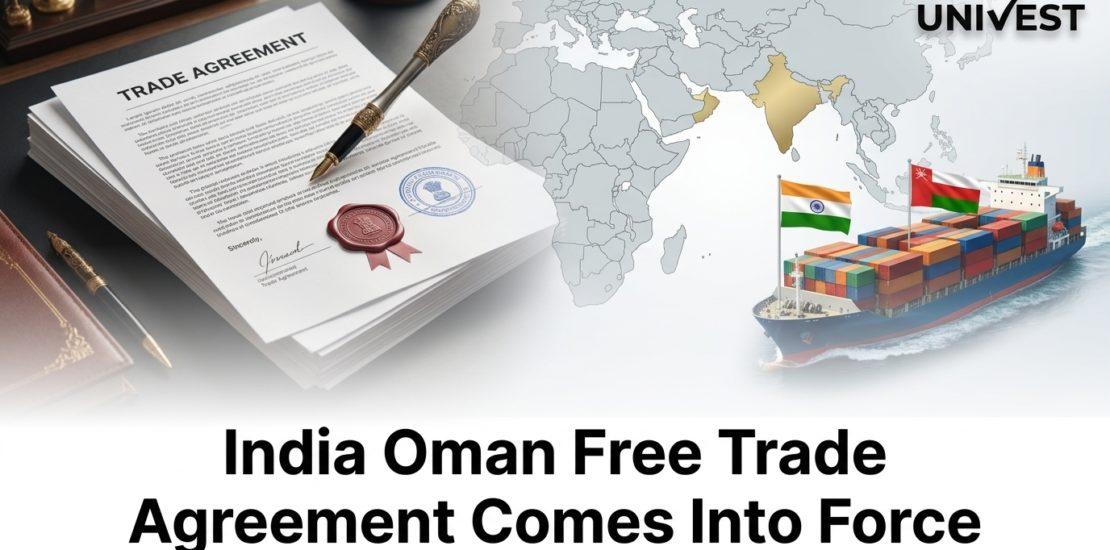
The India Oman free trade agreement officially came into force on June 1, 2026, marking a significant milestone in India’s accelerating trade diplomacy strategy. Commerce and Industry Minister Piyush Goyal announced the agreement’s entry into force, stating that the Comprehensive Economic Partnership Agreement between the two countries would benefit Indian exporters across multiple sectors by granting them preferential access to the Omani market over competitors from third countries. The India Oman free trade agreement was signed on December 18, 2025, in Muscat, and entered into force on June 1 after both India and Oman completed their respective internal ratification procedures. To mark the occasion, about 10 consignments of agriculture and gems and jewellery products were shipped from Mumbai, Kolkata, and Chennai to Oman under the new preferential tariff structure.
Click Here – Get Free Investment Predictions
India Oman Free Trade Agreement: Key Facts at a Glance
| Parameter | Details |
|---|---|
| Agreement Name | Comprehensive Economic Partnership Agreement (CEPA) |
| Signing Date | December 18, 2025 (Muscat, Oman) |
| Entry Into Force | June 1, 2026 |
| Announcement | Minister Piyush Goyal |
| India’s Tariff Liberalisation | 77.79% of tariff lines (covering ~95% of imports from Oman) |
| Bilateral Trade (FY2025-26) | $11.18 billion (up from $10.61 billion in FY2024-25) |
| Oman’s Position in GCC Trade | India’s 2nd-largest GCC trading partner |
| First Consignments Shipped | Agriculture + gems and jewellery from Mumbai, Kolkata, Chennai |
| India’s Export Target | $2 trillion by 2030 (from $776 billion in FY2023-24) |
3 Stocks Building Serious Momentum Right Now
When Univest analysts identify high-conviction stock opportunities, investors pay attention.
Our research team has now shortlisted the Top Stocks to Buy based on current market momentum, sector trends & growth potential for 2026.
- Discover stocks investors are actively accumulating
- High-conviction opportunities backed by research
- Designed for the next phase of market growth
Unlock the latest Top Stock Picks now on Univest
Which Indian Sectors Benefit From the India Oman Free Trade Agreement
The India Oman free trade agreement grants preferential tariff access to Indian exporters across a wide range of sectors. Textiles and garments are among the primary beneficiaries, as the earlier cotton import duty exemption on June 1 has already improved Indian textile manufacturers’ cost competitiveness. With the India Oman free trade agreement now giving Indian textile exporters an additional tariff advantage over competitors from countries without an equivalent deal, Indian garment and yarn exporters can price more aggressively in the Omani market. Commerce Minister Goyal specifically mentioned textiles, leather, plastics, marine products, automobiles, sports goods, and agricultural items as sectors set to gain from the agreement.
Marine products and seafood exporters stand to benefit significantly, as Oman is a major consumer of seafood and Indian marine exports have been growing. Leather and footwear manufacturers from hubs in Tamil Nadu, Maharashtra, and Uttar Pradesh gain price advantages. The India Oman free trade agreement also creates new opportunities for auto component exporters, as Indian manufacturers like Samvardhana Motherson and Minda Industries can access the Omani market with lower duties. Gems and jewellery exporters, one of India’s largest export segments, also benefit from preferential access.
Track all market-moving stocks live on the Univest Screener.
India Oman Free Trade Agreement and the GCC Gateway Strategy
Oman’s strategic importance to India goes beyond bilateral trade. The India Oman free trade agreement provides Indian exporters with access to Oman’s advanced port infrastructure, which serves as a distribution gateway to the wider Gulf Cooperation Council (GCC) market comprising Saudi Arabia, the UAE, Kuwait, Qatar, Bahrain, and Oman. Indian goods landed in Oman under preferential tariffs can access GCC distribution networks, amplifying the effective market reach of the India Oman free trade agreement beyond Oman’s domestic consumption alone.
Oman’s Duqm and Sohar ports are among the most modern in the region and have been actively courting Indian companies to establish manufacturing and distribution operations. The India Oman free trade agreement strengthens this corridor by reducing the cost of importing Indian inputs into Oman-based factories and re-exporting finished goods to other GCC markets. India already has a CEPA with the UAE, and now combining both agreements creates a comprehensive trade architecture for the Gulf region.
Download the Univest iOS App or Univest Android App for live market updates and expert research.
India Oman Free Trade Agreement in the Context of India’s FTA Strategy
The India Oman free trade agreement is part of a significant acceleration in India’s trade diplomacy. India currently has 15 free trade agreements covering 26 countries. In 2025-26 alone, India finalised the long-negotiated FTA with the United Kingdom, signed the Oman CEPA, and accelerated talks with the European Union, New Zealand, and Chile. This push comes directly in response to the US imposing 50% tariffs on Indian goods in August 2025, which has created urgency to diversify export markets. Trade analyst Ajay Srivastava noted that India is clearly using free trade agreements as a strategic tool to diversify export markets and soften the impact of steep and uncertain US tariffs.
Conclusion
The India Oman free trade agreement coming into force on June 1, 2026, marks a significant step in India’s export market diversification strategy. With Oman as a gateway to the broader GCC market and bilateral trade already at $11.18 billion in FY2025-26, the India Oman free trade agreement creates a meaningful preferential advantage for Indian exporters in textiles, leather, automobiles, marine products, gems, and agri-items. As India accelerates its $2 trillion export ambition and counters US tariff headwinds through a broader network of trade agreements, the India Oman free trade agreement is a strategically significant addition to India’s global trade architecture. This does not constitute investment advice.
Investments in securities are subject to market risk. This content is for educational purposes only and does not constitute investment advice.
Frequently Asked Questions on the India Oman Free Trade Agreement
What is the India Oman free trade agreement?
Ans. The India Oman free trade agreement is formally known as the Comprehensive Economic Partnership Agreement (CEPA) between India and Oman. It was signed on December 18, 2025, in Muscat and came into force on June 1, 2026, after both countries completed their internal ratification processes. The India Oman free trade agreement gives Indian exporters preferential tariff access to the Omani market across sectors including textiles, leather, plastics, marine products, automobiles, sports goods, and agricultural items. India has offered Oman tariff liberalisation on 77.79% of its tariff lines, covering nearly 95% of India’s imports from Oman.
Which Indian sectors benefit most from the India Oman free trade agreement?
Ans. The key Indian sectors that benefit from the The trade pact include textiles and garments, leather and footwear, plastic products, marine and seafood products, automobiles and auto components, sports goods, gems and jewellery, and agricultural produce. On June 1, 2026, about 10 consignments of agriculture and gems and jewellery products from Mumbai, Kolkata, and Chennai were shipped to Oman under preferential tariffs to mark the entry into force. Indian exporters in these sectors will now enjoy lower or zero duties compared to competing exporters from countries without such agreements with Oman.
What is the current bilateral trade between India and Oman?
Ans. Bilateral trade between India and Oman reached $11.18 billion in FY2025-26, up from $10.61 billion in FY2024-25. Oman is India’s second-largest trading partner in the Gulf Cooperation Council (GCC) region and serves as a strategic gateway to the wider GCC market through its advanced port infrastructure. The The CEPA is expected to accelerate this bilateral trade growth, with Indian exporters gaining preferential access that will make their products more competitive relative to exporters from other countries.
How does the India Oman free trade agreement help Indian exporters facing US tariffs?
Ans. The This bilateral agreement comes at a strategically important time when Indian exporters face US import tariffs of 50% that went into effect in August 2025. By diversifying export destinations through the The FTA and other FTAs with the UAE, Australia, and the UK, India is using trade agreements as a strategic tool to cushion the impact of US tariffs. Trade analyst Ajay Srivastava noted that India is clearly using free trade agreements to diversify export markets and soften the impact of steep and uncertain US tariffs.
How many free trade agreements does India currently have?
Ans. India currently has 15 free trade agreements covering 26 countries, six preferential trade agreements with another 26 nations, and is negotiating with more than 50 other trading partners. Key FTAs include agreements with the UAE (CEPA), Australia (ECTA), and now Oman. India has recently finalised a long-negotiated FTA with the United Kingdom, is in advanced talks with the European Union, New Zealand, and Chile, and has a bilateral trade agreement under negotiation with the United States. Once ongoing talks conclude, India will have free trade agreements with virtually all major global economies except China.
What is India’s strategic aim with the India Oman free trade agreement?
Ans. The strategic aim of the The trade deal is threefold: first, to gain preferential access for Indian goods to the Omani market and by extension the broader GCC market through Oman’s port infrastructure; second, to reduce dependence on the US market by building a diversified global export network; and third, to support India’s stated export target of $2 trillion by 2030, from $776 billion in FY2023-24. The The trade pact is part of India’s broader trade policy pivot that has accelerated sharply in 2025-26 as US tariff uncertainty mounted.
Will the India Oman free trade agreement benefit Omani exports to India?
Ans. Yes, the The CEPA also benefits Omani exporters gaining access to India’s large and growing market. India has offered tariff liberalisation on 77.79% of its tariff lines, covering nearly 95% of India’s current imports from Oman. Oman’s key exports to India include petroleum products, fertilisers, chemicals, and minerals. The trade agreement reduces duties on these products, making Omani exports more competitive in the Indian market and supporting Oman’s national diversification strategy under Vision 2040, which seeks to reduce dependence on oil revenue.
What stocks could benefit from the India Oman free trade agreement?
Ans. Indian listed companies that could benefit from the This bilateral agreement include exporters in the textiles sector (Vardhman Textiles, KPR Mill, Arvind Ltd, Gokaldas Exports), marine products and seafood exporters, leather goods manufacturers, auto components exporters (Samvardhana Motherson, Minda Corporation), and gems and jewellery companies. Companies with existing operations or distribution in the GCC region stand to gain from improved tariff terms. Investors should conduct their own research and consult a SEBI-registered financial advisor before making investment decisions. This does not constitute investment advice.
